


e left Theodosia in that most distressful condition, in which duty, struggling with inclination, distracts and rends the mind with agonizing efforts to decide one way or the other.
With her this was not a slight or momentary strife. It was the terrible agony of one who struggles for his very life. Dearer to her than life was Mr. Percy’s love; it was her first love; it was her only love; it was a pure and holy love; it had been sanctioned by her mother’s fond approval; it had been sanctified by their formal espousals; the day had been set for the consummation of their happiness; she had fully given up her whole heart to it; it was the great, controlling, soul-absorbing passion of her being; all the hopes of life were centered here. To tear such love from out the heart, was to rend the heart itself. Yet she felt it must be done; and God gave her strength to do it. All day long, as we said, she had crouched at her mother’s side, or followed her like her shadow. She seemed to feel that something terrible impended over her, and that she was safer in her mother’s presence. Not one word was spoken by either of them on the one subject which occupied the minds of both. Mrs. Ernest observed that, as the day advanced, her daughter’s face became more natural in its expression. The lines of agony began to disappear. The eyes no longer looked so strange and restless; nor did they turn to [252]her, as in the morning, with that beseeching gaze of agony which almost broke her heart. But still, she noticed that her lips often moved, though she uttered no word; and when she spoke to her about the business of the household, it was some time before she answered, and then slowly, and often in such a way as to show that she had not fully comprehended her meaning. Her mind was evidently far away.
About three o’clock she laid down her worsted, and taking up the Testament which lay upon her work table, turned to the fourteenth chapter of Luke, and read: “If any man come to me and hate not his father and mother, and wife and children, and brethren and sisters, yea, and his own life also, he cannot be my disciple; and whosoever doth not bear his cross and come after me, cannot be my disciple. For which of you, intending to build a tower, sitteth not down first and counteth the cost, whether he have sufficient to finish it, lest haply after he hath laid the foundation and is not able to finish it, all that behold it begin to mock him, saying, This man began to build, but was not able to finish. Or what king going to make war against another king, sitteth not down first, and consulteth whether he be able, with ten thousand, to meet him that cometh against him with twenty thousand? or else, while yet the other is a great way off he sendeth an ambassage, and desireth conditions of peace. So likewise whosoever he be of you that forsaketh not all that he hath, he cannot be my disciple.”
“Mother,” said she, looking up, and speaking as though her mother had known what she was reading, “you will not make it necessary for me to forsake you too?”
“Why, what do you mean, my daughter?”
[253]“Jesus says here, that if I do not forsake all for him, I cannot be his disciple.”
“Yes, my child, but that has nothing to do with baptism. It means that you must give up all to be religious.”
“To be religious, mother, is to obey Jesus Christ. ‘If ye love me,’ he says, ‘keep my commandments.’ One of the plainest and most positive of those commandments is, ‘Believe and be baptized.’ Baptism is commanded as much as faith. It makes, indeed, a part of the same command. I trust I have believed; but I have never been baptized. Even if the sprinkling which I received in my childhood had been baptism, it was no act of mine. I have not obeyed: I—must—do—it!” She pronounced these last four words slowly, with a slight pause between each of them, as though each cost her heart a pang to speak it, and yet it must be said.
“Well, my child, if you must, you must.”
“But, mother, you will not forbid me? You will not make it needful to disobey you as well as to—” But she could not finish the sentence, and left her mother to guess her meaning.
“No, my dear child, I will not absolutely forbid you. You know what I think about these things. Baptism is not essential to salvation, and I had much rather you would remain where you are. I cannot bear to see you sacrifice all your prospects in life for a mere whim, for I don’t see but what one baptism is just as good as another. And if you were not in such distress, I would certainly oppose you, but I see it would do no good; and though it will mortify and distress me, I will not forbid you. And if you are determined to do it at all hazards, and it will relieve you of a single pang, I give you my consent.”
“Thank you, mother! You do not know what a load [254]you have taken off my heart.” And she buried her face in her mother’s lap, and wept aloud for several minutes. Then she arose, wiped her eyes, and went into her own room and closed the door.
Shall we invisibly follow her there; see her on her bended knees pour out her soul to God; hear her cry for help with those inarticulate groanings which the Apostle speaks of; see the resolve take form and substance in her heart; see her arise with that same strange calmness which we observed after she had prayed the day she came up from witnessing the baptism in the river; see her open her little writing- desk, and select a sheet of paper; take her pen and write, “My Dear Mr. Percy;” then pause, lay down her pen, cover her face with her hands, pressing upon her eye balls, as if to shut out some terrible vision, while a strong convulsive shudder quivers through her frame? It is past; she uncovers her face; looks up beseechingly to heaven; composes herself; takes up her pen, and writes as follows:
“I received yours on Friday evening. To say that its contents gave me very great pain, would but feebly express the truth. I was not only distressed, but most grievously disappointed; for I had supposed you were as sincere and earnest in your desire to know and do your whole duty in regard to this subject as I was myself. Your letter undeceived me. I do not complain of it. I am thankful for your expressions of interest in my welfare, and of affection for myself. I will not deny that I had no higher ambition, so far as this world is concerned, than to secure your approbation. But I cannot, even to please you, venture to disobey my Saviour, I intend to be baptized to- morrow. I am aware, after what you have said, that by doing so, I shall not only [255]‘mortify and distress’ you, but I shall renounce all claim to your love. When you return, therefore, I shall be to you but as one dead. I pray you so to consider me; it will be better for us both. And if you will spare me farther pain, I do entreat you never to solicit a renewal of our engagement. It will not give you as much pain to read this as it does me to write it; but I have weighed it well. I say every word deliberately, though sorrowfully. I will not cease to pray for you. And will you not sometimes pray for her who was your
“Theodosia.”
This letter she folded, enclosed, sealed, and directed to Mr. Percy’s lodging place, and called the old servant, Aunt Chloe, and directed her to take and leave it there.
This done, she returned to her mother with something almost like a smile of joy upon her face. The peace of God was in her heart; and if she was not happy, she was no longer wretched. With a low, but calm and almost cheerful voice, she told her mother what she had done, and asked her to make suitable preparation for her baptism. At night she sent a line to Uncle Jones, requesting him, if he could, to be present; and another to Mr. Courtney, announcing her intention to ask for baptism. She spent most of the time in her own room, alone, until the hour of rest, and then slept sweetly till morning. When she awoke, her first thought was expressed in the language of the Psalmist—“I laid me down and slept; and I awoke again, for the Lord preserved me.” She felt now that she was, in a peculiar sense, in the care of God. She had given all, and had obtained all. She had given up self, and obtained Jesus in all his fullness, and God in all his boundless power and love. Jesus was her Saviour; God was her God. Yes, the mighty Maker of the worlds, the omnipotent [256]Ruler of the Universe, was not only her God, but her Father. She felt this morning that she might ask what she would. And yet such was the overwhelming conviction in her heart, that her loving Saviour and her kind Father knew so infinitely better than herself what she most needed, and what would be really best, that she could only pray: “‘Thy will be done;’ I leave it all with thee. Do what thou seest best. Give joy or sorrow; give comfort or affliction; give life or death. Thou knowest best—thou dost all things well. I trust myself— my soul and body; my happiness here and hereafter; all I am, all I have; all I feared, all I hoped for—I give all up to thee. Thou only art my portion now; and I am thine—all thine; I delight to do thy will, oh, my Beloved. I have now no other love but thee, my Saviour, my Father, my Friend. Thou art my all. Jesus is mine, and I am his. What can I want beside? Blessed Saviour, may I never leave thee—may I never grieve thee any more. Lord, thou knowest all things. Thou knowest that I love thee. Yes, I love thee, and I will keep all thy commandments. Show me thy ways. Thou shalt guide me by thy counsels, and afterward receive me into thy glory. Yes, me—even me—poor, lost, rebellious sinner that I am. Thou wilt love me freely. Thou wilt save me through thine own infinite mercy. Mercy, all mercy. Not for works of righteousness which we have done, but of his own mercy, he saves us. Jesus, I thank thee. Oh, make me love thee more.”
With such incoherent ejaculations of trust, and praise, and prayer, she rose, and prepared for church.
It was strange how the news had got abroad, yet it had spread like wild- fire through the town that Miss Theodosia Ernest would that morning apply for baptism. At an early hour the school-house was crowded to its utmost capacity, and before the services commenced, [257]even the windows and the doors, and every place was occupied from which one could hope to catch a glimpse at what was going on within, or hear a word of what was said.
The church bells began to ring. Mrs. Ernest had all the morning been distracted between affection for her lovely child, which prompted her to go to the school-house, and pride, which urged her to go and sit in her own pew as though nothing had happened. Curiosity to see and hear what Theodosia would do and say, and what sort of people these Baptists were, joined with affection in pleading for the school-house; and a sort of indefinite dread of what Mr. Johnson might say, came to the help of pride. And, it may be, there was something like a mistaken sense of religious duty which spake on that side also. However this may be, the first few strokes of the costly and solemn-sounding bell which had been accustomed to call her to church, seemed suddenly to decide her.
“I want you to understand, Theodosia,” said she, “that though I do not forbid, yet I do not altogether approve of what you are about to do, and I cannot sanction any such proceedings by my presence. I don’t know what Mr. Johnson would think of me, if I should forsake our own dear church to wander about after these new comers.”
This was a new disappointment to the sensitive child. She had greatly relied on her mother’s presence to sustain her in the untried scenes through which she was about to pass. She had also hoped that Uncle Jones would call and go with her, but he had not come, and she was alone. Yet she was not alone, for she looked up as her mother was speaking, and in her heart said again, “Not my will, but thine be done!”—And the Spirit replied, “Fear not, for I am with thee; and be not dismayed, [258]for I am thy God!” “When my father and my mother forsake me the Lord will take me up.”
I do not say that she felt no natural misgivings, no modest shrinking from going alone into a house filled with strangers, with the consciousness that every eye was on her, and every heart full of curiosity to see how she would look, what she would do, and what she would say; but she thought much less of this than my reader would naturally suppose. The peace of God was in her heart, and it gave to her mind and her manner a quiet yet determined calmness, and a collectedness of thought and perfect self-possession which was surprising even to herself.
She set out therefore alone; for Edwin had not returned from Sabbath- school. Two or three times the mother turned and looked after her as she went, and wished she could consistently, and without displeasing Mr. Johnson, have gone with the dear child.
Mr. Courtney had taken it for granted that Uncle Jones or some of the family would accompany her, and when he saw her coming by herself, he hastened to meet her, and conducted her to a seat.
The preacher was not the same who had been there before, but a stranger who had providentially been sent to fill his place. He was a man about forty years of age, rather below than above the ordinary size; his complexion dark, his hair slightly silvered with gray, and the top of his head almost bald. His eyes, and indeed the whole expression of his face, were somewhat peculiar. He seemed to have been long in feeble health, and his face was marked with lines of suffering. Its habitual expression was one of sad and sorrowful resignation. The casual observer saw in it no evidence of lofty genius, or of even extraordinary talent—and yet he was an extraordinary man. Though he had but [259]slight acquaintance with the technicalities of logic, he was a clear and powerful reasoner. Though he knew little of the scholastic theories of theology, he was wonderfully familiar with the teachings of Jesus and the Apostles. Though he professed no acquaintance with the metaphysical subtleties of mental philosophy, he knew full well how to convince the understanding and move upon the hearts of his hearers. He was not familiar with the ancient classics, yet his style was pure and strong, and not entirely void of elegance. His tones and gestures were not formed by any rules of oratory, yet he was sometimes very eloquent. When he first rose, there was a slight rusticity in his manner, and something in his dress which for a single moment struck Theodosia unpleasantly; but there was, also, such an air of trusting meekness, that this impression was removed almost as soon as made. His text was John xv. 14—“Ye are my friends if ye do whatsoever I command you.” And the main object of his sermon was to show the vast difference which there is between the so-called obedience which springs from hope, or grows up from fear, and the willing and true obedience of the Gospel which is produced by love. It was a deep, heart-searching discourse, and must have left on every attentive bearer’s mind the sad conviction that genuine Gospel obedience is much more rare than is commonly imagined. We cannot follow him through all his argument; but we may not omit one portion of it. “The obedience of love,” said he, “makes no division of Christ’s commandments into essential and non-essential. ‘Ye are my friends if ye do whatever I command you,’ whether you think it important or not. We know that we love him when we have respect unto all his commandments. The obedience of hope says, how much must I do to be permitted to enter heaven? The [260]obedience of fear asks, what may I omit to do, and yet escape from hell? The obedience of love simply inquires, ‘Lord, what wilt thou have me to do?’ It does not ask, what must I do? but what can I do to show my love for Jesus? It does not ask how far I can venture to disobey, and keep my hope of heaven? How far off can I follow Jesus, and yet not be disowned of him? Oh, never, never! He who will obey Christ no farther than he may fancy is essential to salvation, has never obeyed him at all. Love of self, not love of Christ, is his controlling motive. He is striving not to please his Saviour but to secure his own personal happiness. Love teaches a different way. Love delights to do his will. Love delights to do all his will. Love never asks, what is essential to salvation? but what did Jesus Christ command? Love never asks, how little may I do? but how much can I do? If he commands, that is reason enough. He is no loving child who will obey his father only in those things which he must do, or be disowned and disinherited. He is no loving child who will do all he dare to grieve a doting parent whom he believes will pardon all, and love him though he grieves him. He who truly loves him will obey his slightest desires as well as his most peremptory commands. He who truly loves will study to know all his will, and in his very heart delight to do it—not to avoid disinheritance—not to secure his estate—not to enjoy his father’s bounty, either present or prospective—but simply because the father wishes, asks it, or commands it.
“And yet men call themselves obedient children of God, while they refuse to do what he commands, because he does not add to the command a promise of heaven or a threatening of hell. Oh, it is terrible to think how fearful will be their disappointment! Obeying only to [261]secure salvation is itself sufficient proof that they have not obeyed unto salvation. Omitting all but what they think essential to salvation is of itself sufficient proof that they have omitted all that is essential to salvation. The faith of the Gospel works by love, and love is obedient to all his commandments, so far as it is able to know and to do them. When, therefore, Christ Jesus gives a plain command, as that to ‘believe and be baptized,’ love will not be content merely to believe. It will do both. It will do whatever Christ commands, and he who stops because there is no penalty of hell fire attached to the last, as there is to the first part of the command, is no friend to Jesus. He does not obey from love to Jesus, but from love to self. And further, the obedience of love takes the command as it is given. It obeys in the same order that Christ requires. It not only does the very acts which he commands, but does them in that very way that he requires them to be done. If Christ commands first to believe and then, when thus prepared, to be baptized, the obedience of love will never venture to reverse Christ’s order. It will not seek to be first baptized and then believe. And as the command requires personal obedience, it will never seek to substitute obedience rendered by another. Christ commands you yourselves in your own right, and for yourselves, to believe, and then to be baptized. It may be you have not done either. Oh, what a fearful state! Not to have even begun to obey! It may be you have believed, but are fancying that an act done by your parents, and your pastor, without your knowledge or consent, and which they called baptism, has released you from the obligation to obey yourself. But do not mistake. The religion of Christ is a personal religion. The obedience it requires is an intelligent and personal obedience. You must be baptized for yourself. It must be an act of [262]your own. He that believeth and is baptized, shall be saved. The one is to be your own act as much as the other. But this command you have never even tried to obey. You have never made the slightest effort. Oh, if you love Jesus, will you not at least try to obey all his commandments?
“One thought more. The obedience of love does what he commands. ‘Ye are my friends, if ye do whatever I command’—not what others may put in the place of it—not what you may fancy would do as well. You are not to ‘teach for doctrines the commandments of men.’ Jesus is the sole Lawgiver of his church. His commandments, given in person or by those who spake as they were moved by his Holy Spirit, we must obey. If he was immersed in Jordan, then John’s baptism was immersion. If John’s baptism was immersion, then the baptism administered by Jesus and his disciples was immersion; for John says, Jesus went into a certain place, and there he tarried and baptized. And John also was baptizing in Ænon at the same time. And the Pharisees heard how that Jesus made and baptized more disciples than John. Whatever one did the other did. It was the same thing, because it is called in the same connection by the same name. And if Jesus and John immersed, it was immersion that he commanded. Yet men have done away with what he commanded, and substituted sprinkling in its place. To believe and be sprinkled, therefore, is not to do whatever he commands, but to teach and practice for his commands the doctrines of men; and of those who do such things he says, ‘In vain do they worship me.’ Don’t call me bigoted for reminding you of this. They are not my words, but the words of Jesus Christ. It is he who says it; and I believe that he means just what he says. Popes and cardinals, bishops and priests, have met in solemn conclave [263]and changed the ordinance of Jesus. They have substituted the sprinkling of infants for the immersion of believers. This was ordained by Christ, and that by anti-Christ. Yet there are many professed believers, men who would be grieved if I should intimate that they did not love the Saviour—who in his name and as his ordinance practice these commandments of men. The very time and place when and where these changes were thus made by popes and councils is recorded by themselves. They claim to have authority as the vicegerents of Christ on earth to make such changes. But the obedience of love will never recognize their rule. It obeys Jesus Christ. It does whatever he commands. And whenever professed religious teachers, whether Catholic or Protestant, teach other commandments as a substitute for his—it rejects them with disdain.”
After the sermon, he came down from the little platform which had been erected for his convenience, and announced the church as ready to receive applicants for membership—requesting if there were any present who desired to unite with it, that they would come forward while the brethren sang a hymn, and take a seat allotted for that purpose.
The brethren immediately commenced singing the hymn—
“’Tis religion that can give
Sweetest pleasures while we live;
’Tis religion can supply
Solid comfort when we die.”
Before they had completed the first couplet, Theodosia arose and walked to the appointed seat. And when they had finished, the minister asked her to give to the church some account of her religious experience, that they might be able to judge of the nature of her faith and hope.
[264]My reader, who is familiar with her strength of mind, firmness of purpose, clearness of conception, and habitual command of the most appropriate language, can form little conception of the surprise which was excited, as much by her manner as her words. She did not wait to be questioned, and simply answer yes or no, as is customary on such occasions; but modestly arose and turned her face to the audience, and began to relate in a low, but still in a perfectly audible voice, her experience of grace before she made any profession of religion. The house was still as death. Every eye was fixed, every ear attentive to even the slightest modulation of her voice. After describing, in her modest and simple, yet most impressive style, her conviction and conversion, she paused a moment, as if to think of the propriety of saying what was yet upon her mind.
“And why,” inquired the minister, who was ignorant of her history, “did you not then unite with the people of God?”
“At that time,” she continued, “I had rarely been in any other but a Presbyterian house of worship. I regarded Presbyterians as the true church of Christ. Perhaps I would not be going too far if I should say, that I regarded them as the only true church, or at least as the only church that was not involved in some most important error of doctrine or practice—it was my mother’s church;” and her voice faltered, and eyes filled with tears, as she said it. “It was the church in which God’s truth had been made effectual to my conversion. I had no shadow of a doubt that it was the church, if not the only church, and with them I did unite. Nor, until last Sabbath, did I ever have a doubt that I was right in doing so. Last Sabbath, you will recollect, one of your number was baptized. I had the curiosity to go to the river. As I saw her plunged beneath the [265]water, the thought impressed itself upon my mind, if that’s baptism, I have never been baptized; for whatever baptism may be, it must always be the same—‘One Lord, one faith, one baptism.’ I went home and commenced a careful and thorough investigation of the subject. I found that it was immersion, and not sprinkling, that Jesus commanded. It was this which he himself; as our Example, submitted to in the river of Jordan. It was this which his disciples practiced in his life. I was this which he commanded after his death. It was this, therefore, which he required of me. I have not yet obeyed him, but I desire ‘to do whatever he commands me.’ Mine is, I humbly trust, the ‘obedience of love.’ I have come here to-day, and it is the first time in my life that I have ever been in a Baptist Church. I have come to ask you to baptize me, if you think me worthy, according to the commandment of the Lord Jesus.”
“Why, this is wonderful!” exclaimed the minister, as she resumed her seat.
“It is the Lord’s doing,” rejoined Mr. Courtney, “and it is wonderful in our eyes.”
“Brethren, what will we do in regard to this application?”
“I move,” said one, “that she be baptized, and received into the fellowship of the church.”
This was, of course, unanimously determined on.
“When will you be baptized, my sister?” inquired the minister.
“As soon as it may suit your convenience, sir. I am ready now.”
“Then after prayer we will at once proceed to the water’s side. Let us pray.”
They kneeled, and offered up a short and fervent prayer that God would own the ordinance about to be administered in his name—bless her who was to be its [266]recipient—fill her with the comforts of the Gospel— make her a faithful and useful Christian, and at death receive her into his heavenly kingdom.
When Satan finds that he cannot prevent the performance of a religious duty, he often strives to render its performance as distressing as he can. Theodosia had not yet left the house before she began to be assailed by the most terrible temptations. First came the magnificent church, with its soft light, its cushioned pews, its richly carpeted aisles, its tasteful and costly pulpit, its deep-toned organ, and its well-trained choir, which had all her life been the accompaniments of her public devotions. And she could not but contrast their rich, luxurious elegance and comfort, with the rough platform, the naked, dirty floor, the hard benches, and harsh, unskillful voices which had surrounded her to-day. In that splendid church she saw her mother weeping over her daughter’s apostasy—her brother showing no interest in her fate—her uncle, whom she loved as a father, and upon whose approbation she had confidently relied, yet he had not come near her, though she had earnestly requested his presence—her pastor, who had taught her in childhood, and prayed over her at her conversion —and there was yet another, whom she now scarcely dared to think of. They were all there—all happy, all united. She only was a poor outcast from all—yes, yes, from all she loved. With her own rash hand she had cut the ties which bound her to her kindred and her friends. She had left all the elegance so congenial to her delicacy and refinement of taste. She had left all the affection so necessary to the very life of her fond, clinging, loving heart, and here she stood alone among these strangers, whom she felt instinctively, with one or two exceptions, had scarcely a sentiment or taste in common with her own. Then, as she was walking to [269]the river, they passed the very spot where she and Mr. Percy stood on the previous Sabbath; and in a single moment, what visions of affluence and ease, of elegant social enjoyment, of domestic bliss—all the happiness of the loved and loving wife, extending down through many long and blissful years—came vividly before her mind. She could see nothing else. She forgot for a moment where she was, and why she came there. She walked on unconsciously. Unconsciously she took the offered arm of the minister as he came to conduct her into the river. The touch of the water recalled her to herself. She paused, and suddenly withdrew her arm, clasped her hands together, and looked up to heaven, and so stood for some moments, lost in silent prayer. Those who could see her face, observed the expression of distress and terror (which they attributed to a natural timidity at entering the water) suddenly gave place to one of joy and confidence as she again placed her arm within the minister’s and walked on. Jesus had heard her prayer—“Oh, Lord, save me! Give me strength to make all this sacrifice for thee! Thou art my Saviour. Thou hast commanded this. I do it in obedience to thee. Oh, leave me not. Help, Lord—I have no other helper—thou art now my all.” And as she prayed, the visions of earthly bliss vanished from before her, and she saw Jesus stretched upon the cross in dying agony, and he seemed to say, “I bore all this for thee.” And she thought of the words of the Apostle—“He died for us.” And as she walked along, she remembered what Jesus said—“Blessed are ye when men shall hate you, and when they shall separate you from their company, and shall reproach you, and shall cast out your name as evil, for the Son of man’s sake. Rejoice ye in that day, and leap for joy—for your reward is great in Heaven.” “And every one that hath forsaken houses, [270]or brethren or sisters, or father or mother, or wife or children, or lands, for my name’s sake, shall receive an hundred fold, and shall inherit everlasting life.”
So fully was her mind occupied with this delightful thought, that she felt no further anxiety, and not the slightest fear. And as she was lifted from the liquid grave, she could not help exclaiming in an audible voice, “Jesus, I thank thee!” And then, as they turned toward the shore, such a gleam of heavenly peace and holy joy illumined her beautiful face, that several of the brethren and sisters who stood upon the bank, simultaneously exclaimed, “Blessed be the name of the Lord!”
“Yes,” she exclaimed, “blessed be his holy name!” And suddenly she stopped, and with a voice which was naturally sweet and powerful, and had been carefully cultivated, and now was rendered deeper and more expressive by intensity of feeling, she commenced singing:
“Jesus, I my cross have taken,
All to leave and follow thee;
Friendless, poor, despised, forsaken,
Thou from hence my all shall be.
And whilst thou shalt smile upon me,
God of wisdom, love, and might,
Foes may hate, and friends disown me,
Show thy face, and all is bright.
Man may trouble and distress me,
’Twill but drive me to thy breast;
Life with trials hard may press me,
Heaven will bring me sweeter rest.
Oh, ’tis not in grief to harm me,
While thy love is left to me!
Oh, ’twere not in joy to charm me,
Were that joy unmixed with thee!”
The effect upon the audience was electrical. Tears streamed from every face; many sobbed and wept aloud. Among these was a voice which instantly fixed her [271][272][273]attention. She looked up among the assembly, and was surprised to see that it had increased since she started into the water to a great multitude. The congregations from several other churches had hurried to the river as soon as they were dismissed from their several places of meeting. Foremost among the crowd stood Uncle Jones, with her mother on one side, and Edwin on the other. It was she that she heard; for when she saw her daughter standing thus alone, and heard her sing, “Friendless, poor, despised, forsaken,” she lifted up her voice and wept. Nor did she weep alone. Strong men, who were not professors of religion, and who were thought to care for none of these things, stood and gazed at that sweet face, all radiant with the love of Jesus, as though it had been the face of an angel; and as they looked, the big tears chased each other down their unconscious cheeks. The brethren and sisters of the church wept; old men and mothers in Israel wept. Young men and maidens wept. But Theodosia heard none, saw none but her mother. As she came to the water’s edge, that mother rushed down to meet her, and clasped her closely to her heart. The brothers and sisters of the church, who were approaching to give her the hand of fellowship, stood respectfully aside.
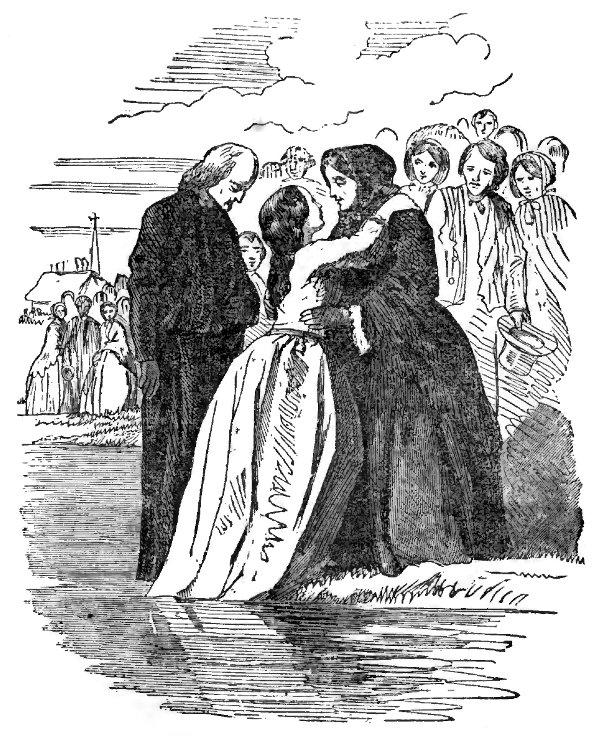
“Oh, mother, do you—can you forgive me?”
“Don’t talk so, my child; I have never blamed you. You have done your duty; you have done right. You have obeyed your Saviour—he will bless you. I wish I had the courage to follow your example.”
“God bless you for those words, my mother! Oh! how full of joy my heart is. He maketh my cup run over. Surely goodness and mercy hath followed me all the days of my life. Uncle, dear uncle, it is blessed to obey. Can’t you give up all for Christ?
“Mr. Courtney, I thank you for your teachings. Now [274]I know I am baptized. I have now done just what Jesus commanded. I have left all and followed him; and, blessed be his name, I have already that peace which passeth understanding.” And as the brethren and sisters came crowding round to welcome her into the communion of the church on earth, she sang again with that sweet, soul-thrilling voice, to which the intensity of her feelings and utter self-abandonment gave tenfold power:
“Children of the living God,
Take the stranger to your heart—
Let me dwell in your abode,
Never more from you to part.
“Can you love me? Will you help me?
Help me on my way to God—
Can you love me? Will you help me?
Help me keep his precious word.”
While singing, she continued to give her hand to one after another as they came up; and as she finished the strain, a sister standing by sang:
“Yes, come, thou blessed of the Lord,
No stranger art thou now—
We welcome thee with warm accord,
Our friend and sister thou.
“The hand of fellowship, the heart
Of love we offer thee;
Leaving the world, thou dost but part
With lies and vanity.
“In weal or woe, in joy or care,
Thy portion shall be ours;
Christians their mutual burdens bear,
They lend their mutual powers.”
The minister pronounced the benediction, and they led her up the bank, and then each went his way rejoicing.
[275]Uncle Jones went home and dined with Mrs. Ernest. When Theodosia had changed her dress, and returned to the parlor, he went up and took her hand as she came in, saying, “My dear Theo., why did you not tell me you were going to be baptized to-day? I would have gladly gone with you to your meeting.”
“Then you did not mean to cast me off?” said she, her eyes filling with tears. “I thought you too had forsaken me. I sent you a line last night, entreating you to be present—but you did not come!”
“I did not get it, nor did I know, till after church, that you intended any such thing to-day. I missed you from your accustomed seat, and inquired of your mother as soon as the meeting was dismissed, and learned that you had gone to be baptized. We hurried to the river, and fortunately were just in time to see you go into the water.”
“Oh, uncle! I am so glad. I thought that you, and mother, and all who loved me, so disapproved of what I was about to do, that you would none of you be present. God is already giving me back my friends.”
There was preaching again at three o’clock,—and as the school-house could not hold half the people, it was thought best to adjourn to the court house. At night the court house was filled to overflowing, and the preacher requested those who were concerned about their souls’ salvation, and desired the prayers of the people of God, to take a seat in front of the congregation. More than a dozen came forward at once, among whom were several who had been a long time professors of religion, and some were members of the Baptist Church. On inquiry, these professors stated that they had been trying to get to heaven, and with this object in view had endeavored to lead in some degree religious [276]lives. They had gone to church, partaken of the Supper, sometimes prayed, or tried to pray—but took no pleasure in religion; and from what they heard in the morning, were convinced that whatever obedience they had shown was the obedience of fear, or hope, and not of love. For if they could have got to heaven without religion, they would have willingly dispensed with it. They had abstained from open sin, because they knew that those who lived in open sin would surely be lost. They had endeavored to perform certain duties, because they considered the attempt (at least) to do such duties to be essential to salvation. What they did not think thus essential, had little weight upon their conscience. Now they saw that they had been fearfully deceived, and desired to seek for the obedience of love—not the obedience which seeks to merit heaven, and continually looks for its reward—but that which receives all mercies as the free gift of God in Christ, and yet longs, and strives, and prays to do all his commandments, because it thus and only thus can exercise, exhibit, and gratify the love of God that fills the heart.
The minister did not try to give them back their hopes, and make them think that they had no occasion for alarm. He knew full well that Christ will say to many, “Depart from me, I never knew you,” who here on earth called him Lord, Lord, and professed to be his disciples. He greatly feared that there were thousands and thousands who had a respectable standing in the church of Christ, who never asked, with the converted Paul, “Lord, what wilt thou have me to do?” But only with the yet unconverted jailer, “What must I do to be saved?” This last he knew was most important, but it was not enough. It was a needful and common preparation for religion, but it was not religion. It might lead to seek for faith, but it is not the result of saving [277]faith, for that works by love—and through Love purifies the heart—and through Love brings forth good works in the life. He was convinced, moreover, that it was infinitely better for many of God’s true children to suffer temporary anxiety and alarm, than for one false professor to be confirmed in his delusive hope.
It was determined at the close of this meeting, to appoint one for Monday night, and probably continue to have preaching every night during the week. Whether they did so, and what was the result, we will learn hereafter. It is time for us now to return to our study, which at the close of the Seventh Night (the attentive reader will perhaps remember) was about the Scriptural authority, or rather about the utter want of all Scriptural authority for infant baptism.
[278][279]