

INTRODUCTION.
Nearly three thousand years have passed since the wisest of men declared that there was nothing new under the sun. The saying has held good to the present day, for men are perpetually finding out that their recent discoveries had been already made, but under circumstances which did not reveal the full value of that which had been discovered. No greater examples of this truth can be adduced than in the history of the Atlantic, of America, and of Australia. Until the days of Prince Henry the Navigator, the Atlantic was so unknown that it justly bore the name of the “Sea of Darkness;” and yet, during the previous two thousand years occasional glimpses of light had in fact been thrown upon the face of that mysterious ocean. “Nil novi sub sole” was still an indisputable proverb. In the researches into the Atlantic originated by Prince Henry, Columbus took part, and hence, as we shall presently more fully see, derived the idea of the great importance of explorations to the West. Within one hundred years of the triumphant rounding by Prince Henry’s navigators (in 1434) of Cape Bojador, which till then had been the limit of Atlantic exploration, the Portuguese had discovered both the eastern and western shores of the continental island [ii]of Australia. And yet till recently men knew not that they owed the knowledge either of America or of Australia[1] to the initiatory efforts of a Prince with whose name, in fact, they were almost entirely unacquainted.
Such facts show the great injustice done to the originators of great explorations who, working with the smallest means, really deserve the highest meed of honour.
Yet in the estimate of merit it must be conceded that priority, immense as are its claims, is not all-absorbent. Columbus, as we shall presently see, was anticipated in the discovery of America, and yet such were the special virtues brought to bear upon the execution of his great achievement, that, as Humboldt has eloquently said, “the majesty of grand recollections seems concentred” on his illustrious name. The peculiar value of the following letters, descriptive of the four important voyages of Columbus, is that the events described are from the pens of those to whom the events occurred. In them we have laid before us, as it were from Columbus’s own mouth, a clear statement of his opinions and conjectures on what were to him great cosmical riddles—riddles which have since been solved mainly through the light which his illustrious deeds have shed upon the field of our observation. In these letters also we trace the magnanimity with which [iii]Columbus could support an accumulated burthen of undeserved affliction. It is impossible to read without the deepest sympathy the occasional murmurings and half suppressed complaints which are uttered in the course of his letter to Ferdinand and Isabella, describing his fourth voyage. These murmurings and complaints were wrung from his manly spirit by sickness and sorrow, and though reduced almost to the brink of despair by the injustice of the king, yet do we find nothing harsh or disrespectful in his language to the sovereign. A curious contrast is presented to us. The gift of a world could not move the monarch to gratitude; the infliction of chains, as a recompense for that gift, could not provoke the subject to disloyalty. The same great heart which through more than twenty wearisome years of disappointment and chagrin gave him strength to beg and to buffet his way to glory, still taught him to bear with majestic meekness the conversion of that glory into unmerited shame.
The translated documents are seven in number. Five of them are letters from the hand of Columbus himself, describing respectively his first, third, and fourth voyages. Another, describing the second voyage, is by Dr. Chanca, the physician to the fleet during that expedition, and the seventh document is an extract from the will of Diego Mendez, one of Columbus’s officers during the fourth voyage, who gives a detailed account of many most interesting adventures undertaken by himself, but left undescribed by Columbus.
[iv]
I shall not pause here to enter into the important bibliography of these documents, which has no charm for many readers, and is therefore placed at the end of this introduction. A series of original documents of such importance might appear to need but few words of introduction or recommendation, since the entire history of civilisation presents us with no event, with the exception perhaps of the art of printing, so momentous as the discovery of the western world; and, independently of the lustre which the grandeur of that event confers upon the discoverer, there is no individual who has rendered himself, on the score of personal character and conduct, more illustrious than Christopher Columbus. There have, nevertheless, not been wanting those, who, from various motives, and on grounds of various trustworthiness, have endeavoured to lessen his glory, by impeaching his claim to the priority of discovery, or by arguing that the discovery itself has proved a misfortune rather than advantage to the world at large. By way, therefore, of vindicating the value of the original documents here translated, a brief account of such pretensions to prior discovery as have been at different times put forth, may not be thought superfluous.
The oldest story which seems possibly to bear reference to what we call the “new world” is related by Theopompus.
Theopompus lived in the fourth century before the Christian era; in a fragment of his works preserved by Ælian is a conversation between Silenus [v]and Midas, King of Phrygia, in which the former says that Europe, Asia, and Africa were surrounded by the sea, but that beyond this known world was an island of immense extent, containing huge animals and men of twice our stature, and long-lived in proportion. There were in it many great cities whose inhabitants had laws and customs entirely different from ours. Fabulous as the story is as a whole, we cannot escape from the thought that it suggests, though vaguely, a notion of the real existence of a great western country. This idea is strengthened by the remarkable story related to Solon by a priest of Sais from the sacred inscriptions in the temples, and presented to us by Plato in his Timæus and Critias, wherein he speaks of an island called Atlantis, opposite the Pillars of Hercules, larger than Africa and Asia united, but which in one day and night was swallowed up by an earthquake and disappeared beneath the waters. The result was that no one had since been able to navigate or explore that sea on account of the slime which the submerged island had produced. Many as have been the doubts and conjectures to which this narrative has been subjected by the learned in ancient and modern times, it is a remarkable fact that Crantor, in a commentary on Plato quoted by Proclus, declares that he found this same account retained by the priests of Sais three hundred years after the period of Solon, and that he was shown the inscriptions in which it was embodied. It is also deserving of notice that precisely in that part [vi]of the ocean described in the legend we find the island groups of the Azores, Madeira, the Canaries, and a host of other rocks and sand-banks, while the great bank of varec, or floating seaweed, occupying the middle portion of the basin of the North Atlantic, and covering, according to Humboldt, an area about six times as large as Germany, has been reasonably regarded as explanatory of the obstacle to navigation to which the tradition refers.
Various have been the speculations respecting the original colonisation of the western hemisphere. Athanasius Kircher, in his Prodromus Coptus and Œdipus Ægyptiacus, gives the Egyptians the credit of colonising America, as well as India, China, and Japan, grounding his argument upon the religious worship of the sun, moon, stars, and animals. Edward Brerewood, at pages 96 and 97 of his Enquiries touching the Diversity of Languages, contends, and he is far from being alone in his opinion, that the Americans are the progeny of the Tartars. Marc Lescarbot, in his Histoire de la Nouvelle France, maintains that the Canaanites, when routed by Joshua, were driven into America by storms, and that Noah was born in America, and after the flood showed his descendants the way into their paternal country, and assigned to some of them their places of abode there; while Hornius, in his treatise De originibus Americanis, after touching upon the various conjectures here quoted, animadverts on the presumption and folly of Paracelsus, when he states that a second Adam and Eve were created for the peopling of the western world.
[vii]
The first specific statement, however, of a supposed migration from the shores of the old world to those of the new, is that which the elder De Guignes presumes to be demonstrable from the relation given by a Chinese historian, Li-Yen, who lived at the commencement of the seventh century. (See Mémoires de l’Académie des Inscriptions et Belles Lettres, vol. 28, p. 504.) The said historian speaks of a country, named Fou-sang, more than forty thousand li[2] to the East of China. He says that they who went thither started from the province of Leaton, situated to the north of Peking; that after having made twelve thousand li, they came to Japan; that travelling seven thousand li northward from that place, they arrived at the country of Venchin, and at five thousand li eastward of the latter, they found the country of Tahan, whence they journeyed to Fou-sang, which was twenty thousand li distant from Tahan. From this account De Guignes endeavours, by a long chain of argument, to prove that the Chinese had pushed their investigations into Jeso, Kamtschatka, and into that part of America which is situated opposite the most eastern coast of Asia.
This surmise of De Guignes has been answered by Klaproth, in a paper which appeared in the Nouvelles Annales des Voyages (tom. 51, 2ᵉ serie, p. 53). His arguments go to show that the country named Fou-sang is Japan; and that the country of Tahan, situated to the west of Asiatic Vinland, can only be [viii]the island of Saghalian. Humboldt observes upon this subject, that the number of horses, the practice of writing, and the manufacture of paper from the Fou-sang tree, mentioned in the account given by the Chinese historian, ought to have shown De Guignes that the country of which he spoke was not America.
The presumed discovery of America which comes next in chronological rotation, is that by the Scandinavians, the earliest printed allusion to which occurs in Adam of Bremen’s Historia Ecclesiastica Ecclesiarum Hamburgensis et Bremensis, published at Copenhagen, 1579, 4to. The Baron Von Humboldt has asserted that the merit of first recognising the discovery of America by the Northmen, belongs indisputably to Ortelius, who, in his Theatrum Orbis Terrarum, with unjust severity says, that Christopher Columbus had done nothing more than to place the new world in a permanently useful and commercial relationship with Europe. The ground upon which the priority is claimed for Ortelius, is that the first edition of his work came out in 1570, although the reference which Humboldt himself gives is to an edition of 1601 which was after the death of Ortelius, and the earlier editions do not contain the chapter on the Pacific Ocean in which the passage occurs. It is true that in the Bibliotheca Hulthemiana the edition of 1601 is said to have been revised and augmented by Ortelius before his death in 1598, but, even if the assertion was made by Ortelius, and not by the editor of his work after his death, it still leaves perfectly [ix]unimpeached the claim to priority of the Copenhagen edition of Adam of Bremen in 1579. Adam of Bremen’s work was written soon after the middle of the eleventh century, and was followed in the next half century by the Historia Ecclesiastica of Ordericus Vitalis, who also speaks of the country visited by the Scandinavians. Abraham Mylius, in his Treatise de Antiquitate Linguæ Belgicæ, Leyden, 1611, makes all Americans to be sprung from Celts; stating that many Celtic words were to be found in use there; and with more reasonable showing affirms that the coast of Labrador was visited by wanderers from Iceland. Hugo Grotius, in his Dissertatio de Origine Gentium Americanarum, (Paris, 1642, 8vo.), follows Mylius, and states that America was colonised by a Norwegian race, who came thither from Iceland, through Greenland, and passed through North America down to the Isthmus.
The earliest printed detail of these discoveries is given by the Norwegian historian, Thormodus Torfæus, in a work entitled Historia Vinlandiæ Antiquæ, ex Antiquitatibus Islandicis in lucem producta, (Hauniæ, 1705, 12mo.) But in the invaluable work by Professor Rafn, published in 1837 by the Danish Royal Society of Antiquaries, under the title of Antiquitates Americanæ, the manuscripts which record these discoveries are given at length in the original, accompanied by a Latin translation, and careful and learned geographical illustrations. The following is a summary of the principal events recorded in this highly interesting volume, and the geographical [x]inferences are those supplied by the professor himself.
Irish Christians were the first Europeans, which we know from well established history, to have migrated into and inhabited Iceland. Close upon the end of the eighth century this island was visited by Irish hermits; but the first discovery of it by the Northmen was made by a Dane named Gardar, of Swedish origin, in the year 863. The regular colonisation of the country was commenced in 874 by Ingolf, a Norwegian, and was carried on continuously for the space of sixty years by some of the most influential and civilised families of Scandinavia. In 877 the mountainous coast of Greenland was for the first time seen by a man named Gunnbiorn, but it was in 983 that this country was first visited by Eric Rauda, or Eric the Red, son of Thorwald, a Norwegian noble, who had been condemned to a banishment of three years for killing Eyolf his neighbour. After three years absence, he returned to Iceland, and in order to hold out an inducement to colonisation, named the newly discovered country Greenland, intending by that name to express the richness of the woods and meadows with which it abounded. Amongst those who had accompanied Eric was a man named Heriulf Bardson, who established himself at Heriulfsnes. Biarne, the son of the latter, finding, on his return home from a trading voyage to Norway, that his father had quitted Iceland, resolved upon following him, though he, as well as those who had accompanied him, were quite unacquainted [xi]with the Greenland sea. Soon after leaving Iceland they met with northerly winds and fogs, and were carried they knew not whither: the weather clearing, they found themselves near a flat woody country, which, not corresponding with the descriptions of Greenland, they left to larboard. After five days’ sailing with a south-west wind, they came to a mountainous country, covered with glaciers, which they found to be an island; but as its appearance was not inviting, they bore away from the island, and standing out to sea with the same wind, after four days’ sailing with fresh gales, they reached Heriulfsnes in Greenland.
Some time after this, in the year 1000, Lief, son of Eric the Red, equipped a ship with thirty-five men to make a voyage of discovery, with the view of examining the new found lands more narrowly. They came to a land were no grass was to be seen, but everywhere there were vast glaciers, while the space intervening between these ice mountains and the shore appeared as one uninterrupted plain of slate. This country they named Helluland, i. e. Slate-land (Newfoundland). Thence they stood out to sea again, and reached a level wooded country, with cliffs of white sand. They called this country Markland, i. e. Woodland (Nova Scotia). Again they put to sea, and after two days’ sail reached an island, to the eastward of the mainland, and passed through the strait between this island and the mainland. They sailed westward, and landed at a place where a river, issuing from a lake, fell into the sea. Here they wintered and built [xii]houses, which were afterwards called Leifsbuder (Leifsbooths.) During their stay, one of their number, named Tyrker, a German, happened to wander some distance from the settlement, and on his return reported that he had found vines and grapes. These proving to be plentiful, Lief named the country Vinland or Vineland (New England), and in the ensuing spring returned to Greenland. In the year 1002, Thorwald, Lief’s brother, being of opinion that the country had been too little explored, borrowed his brother’s ship, and with the assistance of his advice and instructions, set out on a new voyage. They arrived at Liefsbooths, in Vinland, remained there for the winter, and, in the spring of 1003, Thorwald sent a party in the ship’s long boat on a voyage of discovery southwards. They found a beautiful and well-wooded country, with extensive ranges of white sand, but no traces of men, except a wooden shed which they found on an island lying to the westward. They returned to Liefsbooths in the autumn. In the summer of 1004, Thorwald sailed eastward and then northward, past a remarkable headland enclosing a bay, and which was opposite to another headland. They called it Kialarnes (Keel-Cape). Continuing along the east coast, they reached a beautiful promontory, where they landed. Thorwald was so pleased with the place that he exclaimed, “Here is a beautiful spot, and here I should like well to fix my dwelling.” He had scarcely spoken before they encountered some Skrellings (Esquimaux) with whom they fell to blows, and a sharp conflict ensuing, Thorwald [xiii]received a mortal wound in his arm from an arrow. He died, and was buried by his own instructions on the spot which had excited his admiring remark, the language of which appeared prophetic of a longer stay there than he had at first contemplated.
The most distinguished, however, of all the first American discoverers is Thorfinn Karlsefne, an Icelander, whose genealogy is carried back in the old northern annals to Danish, Swedish, Norwegian, Scottish, and Irish ancestors, some of them of royal blood. In 1006 this chieftain visited Greenland, and there married Gudrida, the widow of Thurstein (son of Eric the Red), who had died the year before in an unsuccessful expedition to Vinland. Accompanied by Snorre Thorbrandson, also a man of illustrious lineage, Biarne Grimolfson of Breidefiord, and Thorhall Gamlason of Austfiord, he set sail in the spring of 1007 with three ships for Vinland.
They had in all one hundred and sixty men, and as they went with the intention of colonising, they took with them a great variety and quantity of live stock. They sailed, first, to the Tresterbyd, and afterwards to Biarney (Disco); then to Helluland, where they found an abundance of foxes; and thence to Markland, which was overgrown with wood, and plentifully stocked with a variety of animals. Proceeding still in a south-westerly direction, with the land on the right, they came to a place where a frith penetrated far into the country; off the mouth of it was an island, on which they found an immense [xiv]number of eyder ducks, so that it was scarcely possible to walk without treading on their eggs. They called the island Straumey (Stream Isle) from the strong current which ran past it, and the frith they called Straumfiordr (Stream Frith). Here Thorhall and eight others left the party in quest of Vinland, but were driven by westerly gales to the coast of Iceland, where some say that they were beaten, and put into servitude. Karlsefne, however, with the remaining one hundred and fifty men, sailed southwards, and reached a place were a river falls into the sea from a lake; large islands were situated opposite the mouth of the river; passing these, they steered into the lake, and called the place Hop. The low grounds were covered with wheat growing wild; and the rising grounds with vines. Here they stayed till the beginning of the year 1008, when finding their lives in constant jeopardy from the hostile attacks of the natives, they quitted the place, and returned to Eric’s fiorde. In 1011 a ship arrived in Greenland, from Norway, commanded by two Icelandic brothers named Helge and Finnboge: to these men, Freydisa, a natural daughter of Eric the Red, proposed a voyage to Vinland, stipulating that they should share equally with her the profits of the voyage. To this they assented, and it was agreed that each party should have thirty able-bodied men on board the ship, besides women; but Freydisa secretly took with her five men in addition to that number. They reached Liefsbooths in 1012, and wintered there; when a discussion arising, Freydisa had the subtlety [xv]to prevail on her husband to massacre the brothers and their followers; after the perpetration of which base deed they returned to Greenland in the spring of 1013.
In his expedition to Vinland in 1007, Thorfinn Karlsefne had been accompanied by his wife, Gudrida, who bore him a son, Snorre, who became the founder of an illustrious family in Iceland, which gave that island several of its first bishops. Among these may be mentioned the learned Bishop Thorlak Runolfson, to whom we are principally indebted for the oldest ecclesiastical code of Iceland, written in the year 1123. It is also probable that the accounts of the voyages were originally compiled by him.
The notices given in these old Icelandic accounts, of the climate, soil, and productions of the new country are very characteristic. It is curious that Adam of Bremen, in the eleventh century, though himself not a northman, states, on the authority of Svein Estridson, the King of Denmark, a nephew of Canute the Great, that the country of Vinland got its name from the vine growing wild there, and for the same reason the English re-discoverers gave the name of Martha’s Vineyard to the large island close off the coast.
It is fortunate that in these ancient accounts they have preserved the statement of the course steered and the distance sailed in a day. From various ancient Icelandic geographical works it may be gathered that the distance of a day’s sailing was estimated at from twenty-seven to thirty geographical miles—German [xvi]or Danish—of which fifteen are equal to a degree, and are consequently equivalent to four English miles. From the island of Helluland, afterwards called little Helluland, Biarne sailed to Herjulfsnes (Ikigeit), in Greenland, with strong south-westerly winds, in four days. The distance between that cape and Newfoundland is about one hundred and fifty miles, which, if we allow for the strong south-westerly gales, will correspond with Biarne’s voyage; while the well-known barrenness of the flats of Newfoundland corresponds with the Hellue, or slates, which suggested the name the Northmen gave to the island.
Markland being described as three days’ sail south-west of Helluland, appears to be Nova Scotia; and the low and level character of the country, covered with woods, tallies precisely with the descriptions of later writers.
Vinland was stated to be two days’ sail to the south-west of Markland, which would be from fifty-four to sixty miles. The distance from Cape Sable to Cape Cod is reckoned at about two hundred and ten English miles, which answers to about fifty-two Danish miles; and in the account given by Biarne of their finding many shallows off the island to the eastward, we recognize an accurate description of Nantucket, and Kialarnes must consequently be Cape Cod. The Straumfiordr of the Northmen is supposed to be Buzzard’s Bay, and Straumey, Martha’s Vineyard, though the account of the many eggs found there, would seem to correspond more correctly [xvii]with Egg Island, which lies off the entrance of Vineyard Sound.
Krossanes is probably Gurnet Point. The Hóp answers to Mount Hope’s Bay, through which the Taunton river flows, and it was here that the Leifsbooths were situated.
The ancient documents likewise make mention of a country called Huitramannaland (Whiteman’s Land), otherwise Irland it Mikla (Great Ireland) supposed to be that part of the coast of North America, including North and South Carolina, Georgia and Florida. There is a tradition among the Shawanese Indians, who emigrated some years ago from Florida and settled in Ohio, that Florida was once inhabited by white people, who possessed iron instruments. The powerful chieftain, Are Marson of Reykianes, in Iceland,—according to the account given by his contemporary Rafn, surnamed the Limerick trader,—was driven to Huitramannaland by storms in 983, and was baptised there. Are Frode likewise (the first compiler of the Landnama, and a descendant in the fourth degree from Are Marson) states that his uncle, Thorkell Gellerson, had been informed by Icelanders that Are Marson had been recognised in Huitramannaland, and was held in high respect there. This statement therefore shows that there was an occasional intercourse in those days between the Orkneys and Iceland, and this part of America.
It is further recorded in the ancient MSS. that the Greenland bishop Eric went over to Vinland in the year 1121; but nothing more than the fact is stated, [xviii]and it simply corroborates the supposition of intercourse between the countries. Again, in the year 1266, a voyage of discovery to the Arctic regions of America is said to have been performed, under the auspices of some clergymen of the bishopric of Gardar in Greenland; and from the recorded observations made by the explorers, would seem to have been carried to regions whose geographical position has been more accurately determined by our own navigators, Parry and the two Rosses. The next recorded discovery was made by Adalbrand and Thorwald Helgason, two Icelandic clergymen, in the year 1285. Contemporaneous accounts state that they discovered a new land to the westward of Iceland, supposed to have been Newfoundland. The last record preserved in the ancient Icelandic MSS. relates a voyage from Greenland to Markland, performed by a crew of seventeen men, in the year 1347. The account written by a contemporary nine years after the event, induces the belief that intercourse between Greenland and America had been maintained as late as the period here mentioned, for he speaks of Markland as a country still known and visited in those days.
The obscurity of many portions of these narratives leaves much to be cleared up with reference to this interesting subject; but their general truthfulness being corroborated by the traces of the residence and settlement of the ancient northmen exhibited in the inscriptions discovered in Kinkigtorsoak, Greenland, and Massachusetts, no room is left for disputing the main fact of the discovery.
[xix]
Between this period and the date of the first voyage of Columbus, the coast of America is reported to have been visited by the Arabians of the Spanish Peninsula, the Welsh, the Venetians, the Portuguese, and also by a Pole in the service of Denmark.
The Arabian expedition is described both by Edrisi and by Ibn-al-Wardi. It appears to have been undertaken by eight persons of the same family, called the Almagrurins or the Wandering Brothers, who having provided themselves with everything requisite for a long voyage, swore they would not return till they had penetrated to the extreme limits of the Sea of Darkness. They sailed from the port of Aschbona or Lisbon, and steered towards the south-west, and at the end of thirty-five days arrived at the island of Gana or Sheep Island. The flesh of the sheep of this island being too bitter for them to eat, they put to sea again, and after sailing twelve days in a southerly direction, reached an island inhabited by people of a red skin, lofty stature, and with hair of thin growth but long and flowing over their shoulders. The inhabitants of this island told them that persons had sailed twenty days to the west without discovering land, and the Arabian brothers, diverted from the pursuit of their hardy enterprise by this discouraging account, retraced their course, and returned safely to Lisbon. From this description the elder de Guignes inferred that the Arabs had either reached the eastern coast of America, or at least one of the American islands; an opinion, however, which appears to have as little to sanction it, as his above [xx]mentioned conjecture that the Chinese had discovered the west coast of America in the fifth century. The Baron von Humboldt concurs with the opinion expressed by the learned orientalist Tychsen in his Neue oriental und exegetische Bibliothek, and repeated by Malte Brun, that the island reached by the Arab wanderers was one of the African islands. This conclusion is drawn from the circumstance that the Guanches, the original people of the Canary group, were a pastoral race, and also possessed the same external characteristics as the islanders here described. Moreover, the fact that the king of the island had an interpreter who spoke Arabic, together with the circumstance that the red men had sailed westward for a month without seeing land, strongly corroborates the opinion advanced. The precise date of this voyage is unknown, but Humboldt presumes that it must have been considerably anterior to the expulsion of the Arabs from Lisbon in 1147; because Edrisi, whose work was finished in 1153, speaks of the occurrence as if it were by no means recent.
It is but upon a slight foundation, that the Welsh have pretended to raise a claim to the discovery; but slight as it is, there is certainly enough to render a decidedly negative assertion on the subject to the full as presumptuous as one decidedly affirmative would be. But as we have no concern with mere conjectures, we must in candour narrate, as succinctly as possible, the grounds upon which these pretensions have been founded.
The first account of this discovery is found in [xxi]Humphrey Llwyd’s translation of the History of Wales, by Caradoc of Llancarvan, published by Dr. Powell in 1584. According to him the occurrence took place as follows:—On the death of Owen Gwynedd, prince of North Wales, in 1169, a contention arose amongst his numerous sons respecting the succession to the crown, when Madawe, or Madoc, one of their number, seeing his native country was likely to be embroiled in a civil war, deemed it more prudent to try his fortune abroad. In pursuance of this object he sailed with a small fleet of ships to the westward, and leaving Iceland on the north, came at length to an unknown country, where everything appeared new and uncommon and the manner of the natives different from all that he had ever seen. The country appearing to him, from its fertility and beauty, to be very desirable for a settlement, he left most of his own men behind him, (amounting, according to Sir Thomas Herbert, to a hundred and twenty), and returning to Wales, persuaded a considerable number of the Welsh to go out with him to the newly discovered country, and so with ten ships he again departed, and bade a final adieu to his native soil. This account of the historian Caradoc of Llancarvan is the only affirmative written document the story has upon which to ground its claim to authenticity, with the exception of an ode, written by a Welsh bard, Meredyth ab Rhys, who died in 1477, fifteen years before Columbus’s first expedition, in which an allusion is made to the event.[3] [xxii]A circumstance which would appear to confirm the truth of Madoc’s voyages, is a peculiar resemblance that has been found between some of the American dialects and the Welsh language; but, as Dr. Robertson reasonably remarks, the affinity has been observed in so few instances, and in some of these is so obscure or so fanciful, that no conclusion can be drawn from the casual resemblance of a small number of words. Dr. Williams adduces in confirmation of his favourite idea the authorities of Lopez de Gomara, Hornius, and Peter Martyr, pretending that they assert that traces of Christianity were found among the Americans by the Spaniards, as well as that there was a tradition among the Mexicans, that many years before a strange nation came amongst them, and taught them a knowledge of God. His references however appear entirely incorrect.
Another pretension to an early discovery of America has been founded upon an account given in a work published in Venice by Francesco Marcolini in 1558, entitled “Dello scoprimento dell’ Isole Frislanda, Eslanda, Engrovelanda, Estotilanda, ed Icaria, fatto sotto il Polo Artico da due fratelli Zeni, M. Nicolò il K. e M. Antonio.” The substance of the account is, that in 1380, Nicolò Zeno, a Venetian noble, fitted out a vessel at his own cost, and made a voyage to the north, with the intention of visiting [xxiii]England and Flanders, but was driven by a storm to Friseland, now proved to be the Færoe Archipelago. Being rescued from the attacks of the natives by Zichmni, a neighbouring prince, Zeno entered into the service of the latter, and assisted him in conquering Friseland and other northern islands. He shortly after dispatched a letter to his brother Antonio, requesting him to find means to join him; whereupon the latter purchased a vessel, and succeeded in reaching Friseland, where he remained fourteen years. During his residence there he wrote to his brother Carlo in Venice, and gave an account of a report brought by a certain fisherman, about a land to the westward. This account stated that about twenty-six years before, the fisherman, when out at sea with four fishing boats, was overtaken by a tempest, which drove them about for many days, and at length cast them on an island called Estotiland, about a thousand miles from Friseland. The inhabitants conveyed them to a fair and populous city, where the king sent for many interpreters to converse with them, but none that they could understand, until a man was found, who had likewise been cast away upon the coast, and who spoke Latin. They remained several days upon the island, which was rich and fruitful, abounding with all kinds of metals, and especially gold. Though much given to navigation, they were ignorant of the use of the compass, and finding the Friselanders acquainted with it, the king of the place sent them with twelve barques to visit a country to the south, called Drogeo. They had nearly perished [xxiv]in a storm, but were cast away upon the coast of Drogeo. The fisherman described this Drogeo as a country of vast extent, and that the inhabitants were naked and eaters of human flesh. He remained many years in the country, and became rich with trafficking between Estotiland and the main land, and subsequently fitted out a vessel of his own, and made his way back to Friseland. His narrative induced Zichmni to undertake a voyage thither, in which he was accompanied by Antonio Zeno. It was unsuccessful: landing on an island called Icaria, they were roughly treated by the inhabitants, and a storm afterwards drove them on the coast of Greenland.
This account was placed in the hands of Marcolini by Nicolò Zeno, a descendant of the family of the explorers, but it had to be made from fragments, he himself having, when a boy, from ignorance torn up a considerable quantity of the original documents, which were letters written by Antonio Zeno to Carlo his brother. In spite of a considerable amount of fable and exaggeration, defects which enter into the majority of early accounts of travel, it is scarcely to be believed that Nicolò Zeno the younger invented this voyage. He was a man of the highest reputation, as may be seen by the encomium passed on him by Francesco Patrizio; see Della Historia dieci Dialoghi di M. Francesco Patrizio, Venetia, 1560, 4to., p. 30 verso. It is well known that the Venetians had made yearly voyages to the north of Europe for at least two centuries before the period in question, and the most important part of Zeno’s publication, [xxv]viz., the map, the original of which is stated to have hung up in his palace since the date of the discovery, bears evidence of a knowledge, however imperfect, of Scandinavian geography. The graduation of this map was inserted by Nicolò Zeno the younger himself, and although inaccurate enough to cause much perplexity to geographers, there is no doubt that Greenland was laid down on it with more correctness than on any map preceding the date of its publication. No map before that time shews the Island of Frisland with names thereon tallying with the names of the Færoe islands. No map before 1558 shews the discoveries of the Northmen in America, nor were any of the Sagas known to the Venetians before that time; nor do any books previous to that period set forth the geography of those parts from which Nicolò Zeno could have stolen information. Moreover the correspondence of the Zeno map with surveys much later, as in Davis’s Straits, is highly corroborative of its genuineness. Mr. Kohl, in his most valuable Documentary History of Discovery of the East Coast of North America, printed by the Maine Historical Society, 1869, 8vo., suggests that Icaria is Helluland or Newfoundland; Estotiland, Markland or Nova Scotia; and Drogeo, Vinland or New England: and he further justly remarks that, assuming that the map is genuine, “it is the first and oldest known to us on which some sections of the continent of America have been laid down.”
On an anonymous map in Weimar of the date of [xxvi]1424, and on a map by Andrea Bianco,[4] in the library of St. Mark, bearing the date of 1436, is laid down a large extent of land, five or six hundred leagues west of Gibraltar, above which is written the word “Antillia.” With reference to this subject, Martin Behaim, on his globe of 1492, says, “In the year 734, after the conquest of Spain by the Mahometans, this island Antillia was discovered and settled by an archbishop from Oporto, who fled to it in ships with six other bishops and other Christian men and women. They built there seven towns, from which circumstance it has also been called Septem Citade, the island of the seven cities. In the year 1414 a Spanish vessel came very near to it.” Of the island of S. Brandan also, which is laid down on charts of the fourteenth century, Behaim says, “In the year 565, Saint Brandan, an Irish bishop, arrived with his vessel on this island, saw there most wonderful things, and returned afterwards to his country.” Another of these fancied islands in the Atlantic was the island of Brazil. So strong was the belief in the existence of these islands, that we find it stated by Pedro de Ayala, a Spanish envoy in England writing to the sovereigns in 1498, that the Bristol men had sent out every year from 1491 (before Columbus’s first great discovery) to 1497, two, three, or four caravels every year in search of the islands of Brazil and the seven cities, at the instigation of John Cabot.
[xxvii]
The following passage occurs in Sir John Barrow’s Chronological History of Voyages in the Arctic Regions, which, if it stated a defensible truth, would present another claim, anterior to that of Columbus, to the discovery of America. The passage is headed “Cortereals, 1500”;—
“The Portuguese, not content with having discovered a route to India, by sailing round the tempestuous extremity to Africa, soon after engaged in an equally dangerous enterprise: that of finding a route to India and the Spice Islands, by sailing westward round the northern extremity of America. This bold undertaking was reserved for the Cortereals, the enlightened disciples of the school of Sagres. The first navigator of the name of Cortereal, who engaged in this enterprise, was John Vaz Costa Cortereal, a gentleman of the household of the infant Dom Fernando, who, accompanied by Alvaro Martens Homem, explored the northern seas, by order of king Affonso the Fifth, and discovered the Terra de Baccalhaos (the land of cod fish), afterwards called Newfoundland. This voyage is mentioned by Cordeiro,[5] but he does not state the exact date, which however is ascertained to have been in 1463 or 1464; for, in their return from the discovery of Newfoundland, or Terra Nova, they touched at the island of Terceira, the captaincy of which island having become vacant by the death of Jacomo Bruges, they solicited the appointment, and in reward for their services the request [xxviii]was granted, their patent commission being dated in Evora, 2nd April, 1464.”
It will be seen by the wording of this passage, that Sir John Barrow has fallen into the inaccuracy of asserting that, in 1463 or 1464, Cortereal was engaged in the enterprise of finding a route to India and the Spice Islands by sailing westward round the northern extremities of America. We must presume that the Portuguese were aware of the existence of the American continent, before they could conceive the idea of sailing westward round its northern extremity. The patent commission of the appointment of Cortereal and Homem to the government of Terceira does not specify that the service for which it was granted, was the discovery of Newfoundland; and, moreover, at the end of Faria y Sousa’s Asia Portuguesa, there is a list of all the armadas which sailed from Lisbon on voyages of discovery between 1412 and 1640, and this expedition is passed by in silence; so that the validity of the whole statement hangs on the authority of Cordeiro: but the account is altogether so extremely improbable, from the very silence of Portuguese writers of the time on so important a subject, as to leave Cortereal but small chance of a successful rivalry with Sebastian Cabot.[6]
The last on the list of those who have been said to [xxix]precede Columbus in the discovery of America is a Polish pilot, named John Szkolny, whose name has been erroneously Latinized by Hornius, Zurla, Malte Brun, Wytfliet, and Pontanus, “Scolvus,” or “Sciolvus.” He was in the service of Christian II of Denmark in the year 1476. He is said to have landed on the coast of Labrador, after having passed along Norway, Greenland, and the Friseland of the Zeni. Upon this subject Von Humboldt thus expresses himself: “I cannot hazard any opinion upon the statement made to this effect by Wytfliet, Pontanus, and Horn. A country seen after Greenland may, from the direction indicated, have been Labrador. I am, however, surprised to find that Gomara, who published his Historia de las Indias at Saragossa, in 1553, was cognizant even at that time of this Polish pilot. It is possible that when the codfishery began to bring the seamen of southern Europe into more frequent connexion with those of the north, a suspicion may have arisen that the land seen by Szkolny must have been the same as that visited by John Sebastian Cabot in 1497, and by Gaspar Cortereal in 1500. Gomara says what is in other respects not quite correct, that the English took much pleasure in frequenting the coast of Labrador, for they found the latitude and climate the same as that of their native land, and the men of Norway have been there with the pilot, John Scolvo, as well as the English with Sebastian Cabot. Let us not forget that Gomara makes no mention of the Polish pilot with reference to the question of the predecessors of Columbus, [xxx]though he is malignant enough to assert that it is in fact impossible to say to whom the discovery of the New Indies is due.”[7]
In the American Philosophical Transactions for 1786, is a letter addressed to Dr. Franklin by Mr. Otto of New York, in which he not only asserts that the illustrious cosmographer Martin Behaim discovered the Azores, but quotes a passage, from what he calls an authentic record, preserved in the archives of Nuremberg, the tenor of which is as follows:—“Martin Behem, traversing the Atlantic Ocean for several years, examined the American Islands, and discovered the strait which bears the name of Magellan, before either Christopher Columbus or Magellan navigated those seas; and even mathematically delineated on a geographical chart for the king of Lusitania, the situation of the coast around every part of that famous and renowned strait.” He also quotes passages from the Nuremberg Chronicle, and from Cellarius, in confirmation of this statement. Don Cristóbal Cladera, in his Investigaciones Historicas, says that, in order to refute these statements, he procured from Nuremberg a description of Behaim’s globe, together with historical notes on the life and family of that geographer, and upon examining these and the unpublished works of the Academia de las [xxxi]Ciencias de Lisboa, he became convinced that the observations of Mr. Otto were totally unfounded; and De Murr, who has well investigated the question, assures us that the passage quoted by Mr. Otto from the Nuremberg Chronicle was not to be found in the German translation of that work by George Alt in 1493. Moreover, the real globe of Behaim, made in 1492, does not contain any of the islands or shores of the New World; a fact which sets at rest the two questions of Behaim’s earlier discovery, or of Columbus gaining his information from Behaim.[8]
From the series of evidences contained in the preceding accounts, the fact that America had been visited by European adventurers before the time of Columbus is rendered too certain to admit of contradiction even from the most sanguine advocate of the glory of the great discoverer. But, on the other side, it cannot be denied that the discovery of Columbus, however much later in date, deserves the meed of highest honour, as being the result of sagacity, judgment and indomitable perseverance, and as having been carried on with an energetic endeavour to bring into active operation the incalculable advantages which it opened up to the world at large. To vindicate the correctness of this statement, it will be well to give a brief sketch of his eventful life, and to pourtray as briefly as we may the high qualities to which, far more than [xxxii]to accidental circumstances, the glory of this great discovery is due. The retrospect of his history will at the same time shew, that while every previous discovery was attributable to accident, the greater portion of the accidental or uncontrollable circumstances in the life of Columbus were such as, instead of assisting him, tended to thwart him at every step of his painful career.
It is generally agreed that his father was a wool weaver or carder. There is reason, however, to presume that though his parentage was humble, he was descended from a family of consideration. On this subject his son, Don Ferdinand, denies[9] with great indignation an assertion which occurs in a curious life of the admiral, inserted in the “Psaltertium Octuplex Augustin Justiniani,” Genoa, 1516, folio, under the comments on the nineteenth psalm, that he was “vilibus ortus parentibus,” and complains that he is falsely called a mechanic.
The date of his birth is a “vexata quæstio,” which it would be well that we should here examine. For settling a disputed question of the kind no process seems so sure as the comparing of statements made by the same individual, if he be a good authority, at different times and under different circumstances. The following are two statements made by Columbus himself at entirely different periods and in an entirely different shape, and yet both having the same result. They are recorded by his son, Fernando, in the Biography of his father, and are as follows: “In his [xxxiii]book of his first voyage [1492] he says, ‘I was upon the sea twenty-three years without being off it any time worth the speaking of, and I saw all the East and all the West, and may say towards the North or England, and have been at Guinea. Yet I never saw harbours for goodness like those of the West Indies,’ and a little further he says, ‘That he took to the sea at fourteen years of age and ever after followed it.’” Now we know for certain that he escaped from Lisbon and came to Andalusia at the close of 1484; that during his stay in Portugal he had made many voyages to Guinea, but that from 1484 until his first great voyage in 1492 he was engaged, not at sea, but in endeavouring to secure the interest of the Spanish sovereigns in his important project. If then we add his twenty-three years of almost constant sea-going to fourteen, his age when he first went to sea, we have thirty-seven years to deduct from 1484, and we find 1447 to be the date of his birth. Again in 1501, many years later, he writes to the Spanish sovereigns as follows: “I went to sea very young and have continued it to this day; ... it is now forty years that I have been sailing to all those parts at present frequented.” What “very young” meant he had already told us; viz., 14, which added to 40 makes 54; and this total deducted from 1501, the date at which he writes, leaves the same date for his birth as that resulting from his former statement, viz., 1447. But for the sake of attaining as near to accuracy as possible, we must not overlook another statement made in 1503 by Columbus himself in his letter to Ferdinand [xxxiv]and Isabella, describing his fourth voyage. He there says “I was twenty-eight years old when I came into Your Highnesses service, and now I have not a hair upon me that is not grey.” It was in 1484 that he went to Spain, and then, as we have seen, terminated those three-and-twenty years of almost uninterrupted sea-faring life of which he speaks. Now, if he were then only eight-and-twenty, he must have first gone to sea at the age of five instead of fourteen, as he himself informs us. Moreover, by that reckoning he would have been only fifty when he died, in 1506, an age entirely incompatible with the statement of Bernaldez, the Cura de los Palacios, who knew Columbus so well, that he died in senectute bonâ, at the age of seventy, more or less. It is intelligible that such a remark should be made of a man of sixty, who had passed through hardships so exhausting to the mind and body as those which had marked the life of Columbus, but scarcely even of him at the age of fifty. It is clear, then, that a mistake has been made in this number 28, but if for it we write 38, it will make the date of Columbus’s birth to be 1446. We have, however, to bear in mind that the two statements previously made by him were of a very general character, in which no month or part of a year was specified. It would therefore seem that, on his own showing, we shall be safe in placing the date of his birth 1446-47, which agrees with the inference of the learned and judicious Muñoz, who places it “por los años 1446,” although he does not show the process by which he arrives at his conclusion.
[xxxv]
With respect to the birthplace of our illustrious navigator, were we to enter into the complex discussions of those who, with different arguments of more or less plausibility, place it in Genoa, Nervi, Savona, Pradello, Cogoleto, Quinto, Bogliasco, Albisola, Chiavara, Oneglia, or the castle of Cuccaro in Monferrato,—we should but launch upon a sea of difficulties, with little hope of a successful voyage. It is difficult to withhold credence from the strong assertion made twice by Columbus in his will, dated 22nd February 1498, that he was born in the city of Genoa; namely,—“I, being a native of Genoa”; and “I desire my said son Diego, or the person who may succeed to the said inheritance, always to keep and maintain one person of our lineage in the city of Genoa ... because from thence I came, and there I was born.”[10] But in like manner we know that Leonardo, who was born at Vinci, persisted in calling himself a Florentine.
Having early evinced a strong inclination for the study of geography, geometry, and astronomy, Columbus found at the college of Pavia an excellent opportunity of gaining a more than superficial acquaintance with the principles of those sciences, and at the same time acquired considerable proficiency in the Latin language. The maritime position and commercial engagements of his native city doubtless suggested and [xxxvi]fostered much of that propensity for a nautical life, that he exhibited at so early an age; and although it appears from several historians that for a short time he worked at his father’s trade, yet this must have been simply during his earliest boyhood, for by his own account he commenced the life of a mariner at fourteen years of age. The piratical character of the sea-faring life of those days necessarily exposed its followers to unceasing hardships and dangers, and the severity of this early discipline must have most materially tended to render available and permanent those distinguished qualities which have subsequently gained for him the admiration of the world: indeed, no career could have been better calculated to develope his peculiar genius, or add fuel to those enthusiastic aspirations which characterised him to the close of his life.
From the period of his going to sea, which was about the year 1460 until the year 1472, we meet with no distinct mention of his name; although in a letter written by him to their Majesties, in 1495, he says: “It happened to me that king Réné (whom God has taken to himself) sent me to Tunis to capture the galley Fernandina, and on arriving at the island of San Pedro, in Sardinia, I learned that there were two ships and a caracca with the galley, which so alarmed the crew that they resolved to proceed no further, but to return to Marseilles for another vessel and more people; upon which, being unable to force their inclination, I yielded to their wish, and having first changed the points of the compass, spread all sail, for it was evening, and at daybreak we were [xxxvii]within the cape of Carthagena, while all believed for a certainty that they were going to Marseilles.” The date of this occurrence is unknown, but the expedient of Columbus to alter the point of the needle, reminds us of his subsequent stratagem, of altering his reckoning, to appease his discontented crew during his first great voyage of discovery.
In the year 1472, however, we have evidence of his having been in Savona, from the fact of his signature having been found appended to the will of one Nicolò Monleone, under date of the 20th March of that year. The document is preserved in Savona, among the notarial archives.
In 1474 we find his name mentioned in a letter addressed by Ferdinand king of Sicily to Louis king of France, the title of which runs thus: “Literæ à Ferdinando Rege Siciliæ ad Ludovicum XI, Galliæ Regem, per Fæcialem missæ, quibus quæritur, quod Christophorus Columbus triremes suas deprædatus sit, postulatque sibi ablata restitui. Datum in Terra Fogiæ die 8 Decembr. 1474.” Then follows a letter in five lengthy clauses, in which it is stated that the said vessels were attacked and taken:—“A Columbo, qui quibusdam navibus præest, Majestatis vestræ subdito.”
The title of Louis’s reply runs thus: “Responsio Ludovici XI quibus promittit restitutionem, excusat tamen Columbum, quod jus sit in Oceano capere naves ab hostilibus terris venientes et saltem bona hostium inde auferre.” These letters are given by Leibnitz, in his Codex Juris Gentium Diplomaticus, [xxxviii]Prodromus, art. 16 and 17; but on the correction of Nicolas Toinard, he acknowledges, in the preface to his Mantissa Codicis, that he had erroneously inserted the Christian name “Christophorus.”
Toinard’s correction went to shew that Leibnitz had confounded the name of Guillaume de Caseneuve, surnamed Coulomp, Coulon, or Colon, as the Spaniards called him, with that of the illustrious discoverer. This acknowledgment by Leibnitz of his error might seem to render useless any reference to the letters in question; but as Christopher Columbus is stated by his son, Don Ferdinand, to have been of the same family as the pirate here mentioned, and also to have been engaged at sea with him and his nephew, it becomes interesting to examine what record exists of these illustrious pirates, and to see how far the assertion of Don Ferdinand bears the semblance of correctness. This Caseneuve, or Colon, is called by Duclos, in speaking of the very circumstance which occasioned these letters, in his Histoire de Louis XI, “Vice-Amiral de France, et le plus grand homme de mer de son temps.” And Zurita, in his Libro 19 de los Anales de Aragon, calls him, “Colon, capitan de la Armada del Rey de Francia.” Garnier, in his Histoire de France, thus relates the circumstance: “Guillaume de Casenove, Vice-Amiral de Normandie, connu dans notre histoire sous le nom d’Amiral Coulon, s’était rendu formidable sur toutes les mers de l’Europe, où il exerçait le métier d’armateur: dans une de ses courses il s’empara de deux riches frégates chargées pour le compte des plus riches [xxxix]négocians de Naples, de Florence, et de plusieurs autres villes d’Italie, qui tout sollicitèrent vivement la restitution de cette importante prise.”
Another exploit, in which this Colon was successfully engaged, was the taking of eighty Dutch ships returning from the herring fishery, in the Baltic, in 1479. Again, another sea-fight related by Marc Antonio Sabelico, in the eighth book of his tenth Decade, is quoted by Don Fernando, where Columbus the younger (described by Sabelico as the nephew, but by Zurita as Francis, the son of the famous corsair), intercepted, between Lisbon and Cape St. Vincent, four richly laden Venetian galleys, on their return from Flanders. Fernando further asserts that his father (Christopher) was present in this engagement, and that after a desperate contest, which lasted from morning till evening, the hand-grenades and other fiery missiles used in the battle, caused a general conflagration among the vessels, which having been lashed together with iron grapplings, could not be separated, and the crews were compelled to leap into the water to escape the fire. He then goes on to say that “his father, who was a good swimmer, finding himself at the distance of two leagues from the land, seized an oar, and by its aid succeeded in reaching the shore. Whereupon, learning that he was not far from Lisbon, where he knew he should find many natives of Genoa, he went thither, and meeting with a gratifying reception, took up his abode in that city.” The engagement here described is shown by various French historians to have taken place in 1485, and as it is certain that [xl]Columbus was in Lisbon prior to 1474 (for in that year he has a letter addressed to him in that city by Paolo Toscanelli, in reply to one written by himself from the same place), this relation by Don Ferdinand assumes a very apocryphal aspect.
With respect to his other statement, that his father was of the same name and family as these two renowned corsairs, it is to be remarked that neither he nor any of the subsequent historians who have claimed this needless honour for the great discoverer, appears to have been acquainted with the real name of the pirates; and as Caseneuve was the strict family name of the latter, and Coulon merely a superadded surname, we may fairly conclude that the claim to consanguinity has no other foundation than the identity in the Spanish language of Columbus’s patronymic with the distinguishing surname of the French vice-admiral.
In the Chronique Scandaleuse (folio 109) this Caseneuve is said to have had a very handsome mansion, named Gaillart-Bois, in the neighbourhood of Notre Dame d’Escouys, in Normandy, at which Louis XI made a stay of two or three days in the month of June 1475, and returned thither also in the following month and stayed there some time. Spotorno suggests that his name of Coulon may have been derived from a place so called in the province of Berri; so that, in addition to the evidence that he was not of the same name or family with Christopher Columbus, there arises strong reason to believe that he was in [xli]reality a Frenchman:[11] in which case it becomes probable that an event which has been generally attributed to him, or to his still more renowned relative François Caseneuve, would be with greater correctness ascribed to the Genoese navigator, Christopher Columbus. It appears that, in a letter dated Terra d’Otranto, 2nd October, 1476 (preserved, according to Bossi, in the royal archives at Milan), addressed to the Duke of Milan by two illustrious gentlemen of that city,—the one Guid’Antonio Arcimboldo, and the other Giovanni Giacomo Trivulzio—the following story is related. It says that the captain of the Venetian fleet, when stationed off Cyprus to defend the island, had twice encountered a Genoese ship, called the “Nave Palavisina,” which he had taken to be a Turkish caracca; and in these two engagements one hundred and twenty of the Turks and Genoese had been killed, and in the Venetian squadron thirty had been killed, and two hundred wounded. The captain appears to have had doubts whether he might not have done wrong, and caused offence to the duke of Milan, who might perhaps be an ally of the Genoese: he therefore goes on to say that his only desire had been to meet with his enemies (the Turks) and plunder them; and adds, in confirmation of that assertion, that “a year before he had met with three times as many galleys, who spoke no evil of his good name, and that he found Columbus with ships and galleys, and [xlii]had cheerfully let him pass by, upon which the cry was raised of ‘Viva San Georgio,’ and nothing further passed between them.” The Columbus here mentioned is shewn, by the cry of “Viva San Georgio,” and by the general tenour of the Venetian captain’s letter, to have been a Genoese, and with a Genoese crew; and as it appears probable that the Caseneuves were Frenchmen, and would in all probability sail with French crews, it leaves strong reason to presume that the Genoese captain here mentioned was Christopher Columbus, who is allowed by all his early historians to have been engaged in the Mediterranean about the period referred to.
His son, Ferdinand Columbus, distinctly states that, “it was in Portugal that the admiral began to surmise, that, if the Portuguese sailed so far south, one might also sail westward, and find lands in that direction.”
The period of Christopher Columbus’s sojourn in Portugal was from 1470 to the close of 1484, during which time he made several voyages to the coast of Guinea in the Portuguese service. While at Lisbon he married Felipa Moñiz de Perestrello, daughter of that Bartollomeu Perestrello to whom Prince Henry had granted the commandership of the island of Porto Santo. For some time Columbus and his wife lived at Porto Santo with the widow of Perestrello, who, observing the interest he took in nautical matters, spoke much to him of her husband’s expedition, and handed over to him the papers, journals, [xliii]maps, and nautical instruments, which Perestrello had left behind him.[12]
“It was not only,” says Ferdinand Columbus (see Vida, cap. 8), “this opinion of certain philosophers, that the greatest part of our globe is dry land, that stimulated the admiral; he learned, also, from many pilots, experienced in the western voyages to the Azores and the Island of Madeira, facts and signs which convinced him that there was an unknown land towards the west.” Martin Vicente, pilot of the King of Portugal, told him that at a distance of four hundred and fifty leagues from Cape St. Vincent, he had taken from the water a piece of wood sculptured very artistically, but not with an iron instrument. This wood had been driven across by the west wind, which made the sailors believe, that certainly there were on that side some islands not yet discovered. Pedro Correa, the brother-in-law of Columbus, told him, that near the island of Madeira he had found a similar piece of sculptured wood, and coming from the same western direction. He also said that the King of [xliv]Portugal had received information of large canes having been taken up from the water in these parts, which between one knot and another would hold nine bottles of wine; and Herrera (Dec. 1, lib. 1, cap. 2) declares that the king had preserved these canes, and caused them to be shown to Columbus. The colonists of the Azores related, that when the wind blew from the west, the sea threw up, especially in the islands of Graciosa and Fayal, pines of a foreign species. Others related, that in the island of Flores they found one day on the shore two corpses of men, whose physiognomy and features differed entirely from those of our coasts. Herrera, perhaps from the MSS. of Las Casas, says, that the corpses had broad faces, different from those of Christians. The transport of these objects was attributed to the action of the west winds. The true cause, however, was the great current of the Gulf or Florida stream. The west and north-west winds only increase the ordinary rapidity of the ocean current, prolong its action towards the east, as far as the Bay of Biscay, and mix the waters of the Gulf stream with those of the currents of Davis’ Straits and of North Africa. The same eastward oceanic movement, which in the fifteenth century carried bamboos and pines upon the shores of the Azores and Porto Santo, deposits annually on Ireland, the Hebrides, and Norway, the seeds of tropical plants, and the remains of cargoes of ships which had been wrecked in the West Indies.[13]
While availing himself of these sources of information, [xlv]Columbus studied with deep and careful attention the works of such geographical authors as supplied suggestions of the feasibility of a short western passage to India. Amongst these, the Imago Mundi of Cardinal Pierre d’Ailly (Petrus de Aliaco) was his favourite, and it is probable that from it he culled all he knew of the opinions of Aristotle, Strabo, and Seneca, respecting the facility of reaching India by a western route. Columbus’s own copy of this work is now in the cathedral of Seville, and forms one of the most precious items in the valuable library, originally collected by his son Ferdinand, and bequeathed to the cathedral on condition of its being constantly preserved for public use. It contains many marginal notes in his own handwriting, but of comparatively little importance.
The fondness of Columbus for the works of Pierre d’Ailly, a Frenchman, has caused a recent French writer, M. Margry, to put forth the empty pretension that the discovery of America was due to the influence of French teaching, whereas, not only was the Imago Mundi itself a compilation from ancient authors, but the first edition was not printed till many years after Columbus had devoted himself to the purpose which ended in his great discovery, for his famous correspondence with Toscanelli, of which I shall presently speak, occurred in 1474. M. Margry, indeed, asserts, but without giving his authority, that in the Columbian Library at Seville are D’Ailly’s treatises printed at Nuremberg in 1472. This is in contravention of all the bibliographers—Panzer, [xlvi]Ebert, Hain, Serna Santander, Lambinet, and Jean de Launoy.
The earliest date assigned to the first edition of the Imago Mundi, is about 1480 by Serna Santander, 1483 (?) by Lambinet, while Jean de Launoy, in his Regii Navarræ Gymnasii Parisiensis Historia, Parisiis, 1677, tom. ii, page 478, distinctly gives it the date of 1490. Humboldt, who had Columbus’s copy in his hands, and who, as the subject was especially his own, cannot be suspected of sleeping over such an important point, adopts De Launoy’s date of 1490, while Lambinet gives the queried date of 1483 from actual collation with another work printed in that year, at Louvain, in the very identical type, by John of Westphalia. In the recently published second volume of the Ensayo de una bibliotheca de libros españoles raros, por Don Bartolomé Gallardo, is a list of the books in the Columbian Library, but D’Ailly’s Imago Mundi is not therein mentioned, although his Quæstiones, printed much later by Jean Petit at Paris, a far less important book, is inserted. The omission is to be regretted, as we might have hoped for some illustrative comments from the author.
But perhaps it may be suggested that Columbus may have possessed, or seen, a manuscript copy of Pierre d’Ailly at a yet earlier period. We will willingly suppose it for the sake of the argument; but even then the reasoning will fail, for I find that the very portion of the Imago Mundi, written in 1410, which is assumed to have supplied the inspiration [xlvii]for the discovery of America, and which Columbus quoted in his letter to Ferdinand and Isabella from Haiti in 1498, is taken by Pierre d’Ailly, without acknowledgment, almost word for word, from the “Opus Majus,” of Roger Bacon, written in 1267, a hundred and forty-three years before, as will be seen at page 183 of that work, printed Londini, 1733, fol. See Humboldt, Examen Critique, tom. i, pp. 64-70.
Unfortunately Roger Bacon was not a Frenchman, but there remains for M. Margry the consolatory fact that no Englishman is likely to avail himself of the circumstance which I have just enunciated, to claim for his countrymen the honour of having inspired Columbus with the idea which led to the discovery of America, although, by M. Margry’s process of reasoning, he might do so if he would. True, Roger Bacon had been a student in the University of Paris; but this fact did not communicate the character of French inspiration to the ancient authors whose statements he quotes. True also (but this is a circumstance either unknown to or unnoticed by M. Margry), Ferdinand Columbus tells us that his father was principally influenced in his belief of the smallness of the space between Spain and Asia, by the opinion of the Arab astronomer, Al Fergani, or Alfragan, to that effect; and it is further true that Alfragan is further treated of by Pierre d’Ailly, in his Mappa Mundi. This is a separate work from the Imago Mundi, although it happens to have been printed with it, at a period which we have shown to [xlviii]be posterior to Columbus’s correspondence with Toscanelli, in 1474.
It follows, therefore, that either: 1st, the great explorer obtained his knowledge of Alfragan’s opinion through one of the Arabo-Latin translations, to which he seems to have had recourse during his cosmographical studies in Portugal and Spain (see Humboldt, Examen Critique, tom. i, p. 83), in which case French influence is eliminated; or 2ndly, he derived it from a manuscript of Pierre d’Ailly before 1474, which there is no evidence to show; or 3rdly, he derived it from the printed copy of Pierre d’Ailly, in which case the influence of Alfragan on his mind could not have been primarily suggestive, but only corroborative of conclusions to which he had come several years before that book was printed. And in either of the two latter cases, the information supplied by Alfragan would not become French because adduced by a Frenchman, unless we introduce into serious history a principle analogous to the old conventional English blunder of giving to the toys manufactured in Nuremberg the name of “Dutch toys,” because imported through Holland.
The suggestions derived from these works were corroborated by the narratives of Marco Polo and Sir John Mandeville, whose reports of the vast extent of Asia eastward led to the reasonable inference, that the western passage to the eastern confines of that continent could not demand any considerable length of time. The natural tendency of his thoughts to nautical enterprise being thus fostered by the works [xlix]that he studied, and by the animating accounts of recent adventurers, as well as by the glorious prospects which the broad expanse of the unknown world opened up to his view, we find that in the year 1474 his ideas had formed for themselves a determined channel, and his grand project of discovery was established in his mind as a thing to be done, and done by himself. The combined enthusiasm and tenacity of purpose which distinguished his character, caused him to regard his theory, when once formed, as a matter of such undeniable certainty, that no doubts, opposition, or disappointment, could divert him from the pursuit of it. It so happened that while Columbus was at Lisbon a correspondence was being carried on between Fernam Martins, a prebendary of that place, and the learned Paolo Toscanelli, of Florence, respecting the commerce of the Portuguese to the coast of Guinea, and the navigation of the ocean to the Westward. This came to the knowledge of Columbus, who forthwith despatched by an Italian, then at his house, a letter to Toscanelli, informing him of his project. He received an answer in Latin, in which, to demonstrate his approbation of the design of Columbus, Toscanelli sent him a copy of a letter which he had written to Martins a few days before, accompanied by a chart, the most important features of which were laid down from the descriptions of Marco Polo. The coasts of Asia were drawn at a moderate distance from the opposite coasts of Europe and Africa, and the islands of Cipango, Antilla, etc., of whose riches such astonishing [l]accounts had been given by this traveller, were placed at convenient spaces between the two continents.
While all these exciting accounts must have conspired to fan the flame of his ambition, one of the noblest points in the character of Columbus had to be put to the test by the difficulty of carrying his project into effect. The political position of Portugal, engrossed as it was with its wars with Spain, rendered the thoughts of an application for an expensive fleet of discovery worse than useless, and several years elapsed before a convenient opportunity presented itself for making the proposition.
Meanwhile Columbus was not idle. In the year 1477, he tells us, in a letter quoted by his son, Don Ferdinand, that “he sailed a hundred leagues beyond the island of Thule, the southern part of which is distant from the equinoctial line seventy-three degrees, and not sixty-three, as some assert; neither does it lie within the line which includes the west of Ptolemy, but is much more westerly. To this island, which is as large as England, the English, especially those from Bristol, go with their merchandize. At the time that I was there the sea was not frozen, but the tides were so great as to rise and fall twenty-six fathoms. It is true that the Thule of which Ptolemy makes mention lies where he says it does, and by the moderns it is called Frislanda.” Whether the Færoe islands [see ante, page xxiii], or Iceland, was alluded to is uncertain, for nothing more is known of the voyage than is contained in this letter. It is moreover [li]supposed by his son, as has been already stated, that he passed a considerable portion of his time at sea, with one or both of the famous pirates of the same name, who were so many years engaged in the Levant; but upon the whole of this portion of his history there rests an impenetrable cloud of obscurity.
About the year 1480, by the joint labours of the celebrated Martin Behaim and the prince’s two physicians, Roderigo and Josef, who were the most able geographers and astronomers in the kingdom, the astrolabe was rendered serviceable for the purposes of navigation, as by its use the seaman was enabled to ascertain his distance from the equator by the altitude of the sun.
Shortly after this invaluable invention Columbus submitted to the king of Portugal his proposition of a voyage of discovery, and succeeded in obtaining an audience to advocate his cause. He explained his views with respect to the facility of the undertaking, from the form of the earth, and the comparatively small space that intervened between Europe and the eastern shores of Asia, and proposed, if the king would supply him with ships and men, to take the direct western route to India across the Atlantic. His application was received at first discouragingly, but the king was at length induced, by the excellent arguments of Columbus, to make a conditional concession, and the result was that the proposition was referred to a council of men supposed to be learned in maritime affairs. This council, consisting of the above-mentioned geographers, Roderigo [lii]and Josef, and Cazadilla, bishop of Ceuta, the king’s confessor, treated the question as an extravagant absurdity. The king, not satisfied with their judgment, then convoked a second council, consisting of a considerable number of the most learned men in the kingdom; but the result of their deliberations was only confirmative of the verdict of the first junta, and a general sentence of condemnation was passed upon the proposition. As the king still manifested an inclination to make a trial of the scheme of Columbus, and expressed a proportionate dissatisfaction with the decisions of these two juntas, some of his councillors, who were inimical to Columbus, and at the same time unwilling to offend the king, suggested a process which coincided with their own views, but which was at once short-sighted, impolitic, and ungenerous. Their plan was to procure from Columbus a detailed account of his design under the pretence of subjecting it to the examination of the council, and then to dispatch a caravel on the voyage of discovery under the false pretext of conveying provision to the Cape Verde Islands. King John, contrary to his general character for prudence and generosity, yielded to their insidious advice, and their plan was acted upon, but the caravel which was sent out, after keeping on its westward course for some days, encountered a storm, and the crew, possessing none of the lofty motives of Columbus to support their resolution, returned to Lisbon, ridiculing the scheme in excuse of their own cowardice. So indignant was Columbus at this unworthy manœuvre, that he resolved [liii]to leave Portugal and offer his services to some other country, and towards the end of 1484 he left Lisbon secretly with his son Diego. The learned and careful Muñoz states his opinion that he went immediately to Genoa, and made a personal proposition to that government, but met with a contemptuous refusal; at any rate, we are positively informed by Fernando Columbus that his father went to Spain at the close of 1484. A curious surmise is expressed in a note to Sharon Turner’s History of England in the Middle Ages, in which the supposition is propounded of the possible identity of Christopher Columbus with a person named Christofre Colyns, who is recorded in some grants in the Harleian MSS. to have been military commandant of Queenborough castle, in the isle of Sheppy, in 1484 and 1485. This man is distinctly stated in the same grants to have held that post in April 1485, and it may be reasonably conjectured that the cessation of his office would not take place till the accession of Henry VII, in August in that year, which leaves but little time for his making his way to Genoa, and subsequently reaching Spain, so as to make his application to that court. Moreover, the impoverished condition in which Columbus presented himself at the convent de la Rabida was very incompatible with the probable pecuniary position of a person, who is described by the grants in question not only to have held the prominent station already mentioned, but to have had a ship given him, with an annuity of £100, and an especial grant of money to enable him to supply [liv]himself with habiliments of war. These considerations, combined with the statement of Fernando Columbus just referred to, show that the supposition proposed by Mr. Turner cannot be regarded as tenable.
The interesting story of Columbus’s visit to the Franciscan convent of Santa Maria de Rabida forms the first incident that we find recorded of him after his arrival in Spain. It is well known that the lively interest which the worthy prior of that convent, Fray Juan Perez de Marchena, took in his guest, was the means, through the anticipated influence of his friend Fernando de Talavera, of first leading Columbus to the Spanish court, under the hope of obtaining the patronage of the king and queen. Talavera, who was prior of the monastery of Prado, and confessor to the queen, possessed great political interest. Juan Perez took advantage of this influential position of his friend, and addressed him a letter by the hands of Columbus, strongly recommending the project of the latter to his favourable consideration, and requesting his advocacy of it before the sovereigns. It was in the spring of 1486 that Columbus first ventured to the Spanish court in the hope of gaining a favourable audience. On reaching Cordova, however, he had the mortification to find that Talavera, upon whose influence he mainly relied, regarded his design as unreasonable and preposterous. The court also was at that time so engrossed with the war at Granada, as to place any hope of gaining attention to his novel and expensive proposition out [lv]of the question. At length, at the close of 1486, the theory of Columbus, backed as it was by his forcible arguments and earnest manner, gained weight with the most important personage at court next to the sovereigns themselves. This was Mendoza, archbishop of Toledo, and grand cardinal of Spain; who, pleased with the grandeur of the scheme and the fervent but clear-headed reasoning of Columbus, adopted his cause, and became his staunch protector and friend. Through his means an audience was procured with the sovereigns, and the result of the interview was the expression of a favourable opinion, qualified by the necessity of an appeal to the judgment of the literati of the country. But here again Columbus found himself in a painful predicament, which it required all his knowledge and prudence to escape from with safety. He was examined at Salamanca by a council of ecclesiastics, and had to propound opinions which appeared to be at variance with the descriptions contained in the sacred Scriptures, and that at a period when the expression of any sentiment approaching to heresy exposed its owner to the persecution of the newly established Inquisition. The ignorance of cosmography, and the blind conclusions drawn from various misinterpreted texts of Scripture, formed mighty impediments to the pleadings of Columbus, and he began to find himself in danger of being convicted not only of error, but of heresy. One learned man of the number, however, Diego de Deza, tutor to prince John, and afterwards archbishop of Seville, appreciated the [lvi]eloquent and lucid reasonings of the adventurer, and aiding him with his own powers of language and erudition, not only gained for him a hearing, but won upon the judgments of some of the most learned of the council. Nevertheless, so important a question could not be hastily decided; and the result of the united pedantry and sluggish superstition of the learned body, was to expose the question to protracted argumentation or neglect, while Talavera, who was at its head, and from whom Columbus had hoped to receive the greatest assistance, was too busied with political matters to bring it to a conclusion. At length, in the early part of 1487, the deliberations of the council were brought to a stand-still by the departure of the court to Cordova, and were not resumed till the winter of 1491. During this wearisome period the bustle and excitement of the memorable campaign against the Moors, with its alternations of triumphant festivity, together with the marriage of the princess Isabella to the prince Alonzo, heir apparent of Portugal, were far too engrossing to admit of much attention being given to the schemes of Columbus.[14] At the close, however, of the year 1491, the learned conclave appears to have recommenced its consultations; but upon being [lvii]called upon by the sovereigns for a decision, a report was returned to Talavera that the scheme was considered by the general vote of the junta too groundless to be recommended. Accordingly Talavera was commanded to inform Columbus that the cares and expenses of the war precluded the possibility of their highnesses engaging in any new enterprises, but that when it was concluded, there would be both the will and the opportunity to give the subject further consideration. Regarding this as nothing better than a courteous evasion of his application, he retired wearied and disappointed from the court, and, but for an attachment which he had formed at Cordova which made him reluctant to leave Spain, he would in all probability have repaired to France, under the encouragement of a favourable letter which he had received from that quarter.
The ensuing period till 1492 was spent in a succession of vexatious appeals to the Spanish court, during which he had to contend with every obstacle that ignorance, envy, or a pusillanimous economy could suggest.
At length having overcome all difficulties, he set sail with a fleet of three ships on the 3rd of August 1492, on his unprecedented and perilous voyage. The ordinary difficulties which might be expected to occur in so novel and precarious an adventure were seriously aggravated by the alarming discovery of the variation of the needle, as well as by the mutinous behaviour of his crew; and his life was upon the point of being sacrificed to their impatience, when the fortunate [lviii]appearance of land, on the morning of the 12th of October, converted their indignation into compunction, and their despondency into unbounded joy.
With reference to the identity of the first landing place of Columbus in America, I too readily adopted in 1847 the conclusions of Navarrete that the Great Turk, the northernmost of the Turk islands, was the true landfall. I did so under the following process of reasoning. My predecessors in the consideration of the subject had been the learned Juan Bautista Muñoz in 1793, Navarrete in 1825, Washington Irving in 1828, and the Baron Alexander von Humboldt in 1837. It was the opinion of Muñoz that Guanahani was Watling’s Island. Navarrete, as just shown, placed it in the Grand Turk, far to the east, while Washington Irving and Humboldt made it to be Cat Island to the west. Such different conclusions, formed by thoughtful men from an examination of the diary of Columbus and other early documents, caused me to set a great value upon any modern reconnaissance of the locality which might throw a fuller light upon these documents and perhaps show which of the conclusions was correct. Now, it so happened that a communication made a short time previously to the New York Historical Society by Mr. Gibbs, a resident on Turk’s Island, presented several points of evidence strongly confirmative of the correctness of Navarrete’s deductions. The most important of Mr. Gibbs’s arguments were the following. Columbus states in his journal that there were several islands in sight from Guanahani. [lix]From the island now called San Salvador, Mr. Gibbs found no land visible. The journal speaks of soundings to the eastward of Guanahani: there were none to the eastward of San Salvador. All the marks wanting at San Salvador were found at Turk’s Island. The journal describes Guanahani as well wooded, and having much water; a large lake in the centre, and two several running streams flowing into the sea. Turk’s Island has about one-third of its surface covered with lakes of salt and fresh water; and a few years before vessels had sailed into one of the ponds. Although the island was now without trees, Mr. Gibbs recollected some remains of a forest existing in his youth. Moreover the journal makes no allusion to the Great Bahama Bank, which must have been passed in approaching San Salvador.[15] As Mr. Gibbs’s personal observation thus appeared to corroborate the deductions of Señor de Navarrete, I yielded to this combination of evidence and so submitted it to the reader. Since that time, however, we have seen other arguments advanced, in which local investigation, as well as the examination of the early documents, have resulted in conclusions as divergent as those which preceded them. Captain Becher, R.N., of our own Hydrographic Office, in his Landfall of Columbus, published London, 1856, examining the question from a seaman’s point of view, fell in with the opinion formed by Muñoz in 1793, that Guanahani was Watling’s Island, while Señor de Varnhagen, in his La verdadera Guanahani de Colon, [lx]published at Santiago, 1864, maintains the unique opinion that it was the island of Mayaguana.
Under these circumstances it has become a duty in me to revise my old opinion; and while the process to which I shall resort will, as I hope, finally settle this much vexed question, it is happily one which will not lay me open to the charge of presumption in giving a judicial verdict where men of such high renown have differed. I congratulate myself on having found a means of enabling the reader to judge for himself by a very simple mode of examination. Annexed is a fac-simile of Herrera’s map of the Bahama Islands, as laid down from the original documents in the handwriting of Columbus and his contemporaries, to which, as official historiographer of the Indies in the sixteenth century, Herrera had exclusive access; and side by side with it is a map, reduced from the Admiralty survey, showing those islands as now known, and with their modern names. I indulge the hope that no one will contest the identification[16] of the respective islands [lxi]laid down in the old map with those which I have set forth as their correlatives in the modern one, and if so, the Guanahani of Columbus will be plainly seen to be Watling’s Island. The correctness of this identification is not only confirmed, but made easily perceptible, by the fact that certain islands of the series have retained their ancient names without change from the beginning, thus affording stations for comparison which reduce the chances of error to a minimum. This map of Herrera’s is of especial value for the purpose, because while it embodies the information contained in the map of the pilot Juan de la Cosa, who was with Columbus in his second voyage (1493-96); it has the advantage over the latter in having been made nearly a century later, and so contains the entire chain of islands, many of which had not been explored at the time when De la Cosa laid down his map in 1500. For the satisfaction of the reader, however, a reduction of that part of De la Cosa’s map which shows these islands is here given.
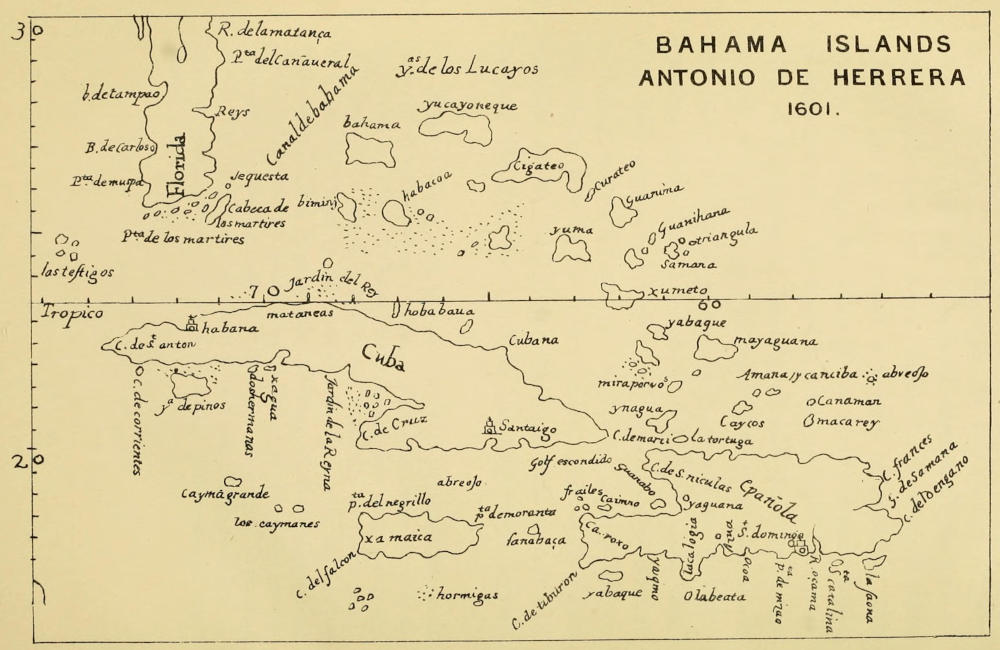
BAHAMA ISLANDS
ANTONIO DE HERRERA
1601.
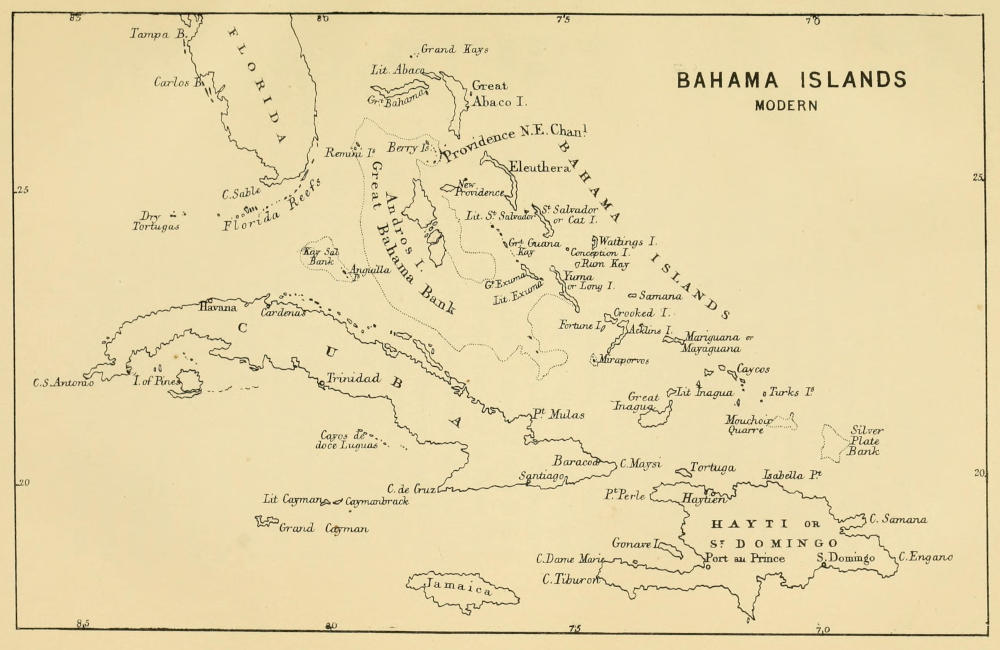
BAHAMA ISLANDS
MODERN
| Herrera | Modern | |
|---|---|---|
| Bahama | Gᵗ. Bahama Iᵈ. | |
| Bimini | } | Andros Iˢ. |
| Habacoa | } | |
| Cabeça de los Martires | Cay Sal Bank | |
| Yucayoneque | Gᵗ. Abaco Iᵈ. | |
| Cigateo | Eleuthera | |
| Curateo | Little S. Salvador | |
| Guanima | S. Salvador or Cat Iᵈ. | |
| Anonymous between Habacoa & Yuma | Great Exuma | |
| Guanihana | Watlings Iᵈ. | |
| Yuma | Yuma | |
| Samana | Samana | |
| Xumeto | Crooked Iᵈ. | |
| Yabaque | Acklin’s Iᵈ. | |
| Mayaguana | Mariguana | |
| Caycos | } | The Caycos Group |
| Amana | } | |
| Canciba | Turks Iˢ. | |
| Abreojo | Mouchoir Carré | |
| Canaman | Silver Plate Bank | |
| Macarey | Navidad or Ship B. | |
| Mira por vos | Miraporvos | |
| Ynagua | Gᵗ. Inagua | |
| La Tortuga | Tortuga |
But while it is hoped that the identity of Guanahani with Watling’s Island will be admitted to be authoritatively established by this comparison, it would be wanting in respect to those who have put forth other claims not to show, I will not say the ground on which these claims were advanced, but rather, for brevity’s sake, the points at which their arguments fail. I adopt this plan on the principle that a chain is no stronger than its weakest link. Of all these I fear none occupies so disadvantageous a position as His Excellency Senhor de Varnhagen; for having unfortunately [lxii]adopted for his protégée an island (Mayaguana), which is represented together with the island of Guanahani both on De la Cosa’s and Herrera’s maps, I regret to say that he seems to me to be ipso facto put out of court, since no reasoning whatever could by any possibility make identical two islands so markedly distinct that several other islands are shown to lie between them. Washington Irving, in advocating Cat Island, or the island at present called St. Salvador, as the genuine Guanahani, adduces an examination of the route of Columbus by Commander Alexander Slidell Mackenzie of the U.S. navy, but which being principally addressed to the disproval of Navarrete’s Turk’s Island, fails to establish Cat Island as the real landfall in contradistinction to Watling’s Island. In examining this route I observe a startling inaccuracy, which underlies the whole question. It is stated that Columbus describes the island as very large. On referring to Columbus’s logbook in Navarrete, I find it, on the contrary, called an “isleta,” or islet, i. e. small island, a term which could scarcely be applied to an island forty-two miles long and the loftiest of the Bahamas, which Cat Island is, whereas it would be correctly applied to Watling’s Island, which is only twelve miles long, cut up by salt water lagoons, separated from each other by small woody hills. At the close, reference is made to the identity preserved to Cat Island as San Salvador with that given by Columbus, and a remonstrance against disturbing the ancient landmarks. But this is a petitio principii, [lxiii]inasmuch as at the period when the name of San Salvador was first continuously applied to Cat Island, viz., the middle of the seventeenth century, both map makers and sailors were possessed of no better materials, nor even so good, as ourselves, for coming to an accurate determination. Humboldt, in accepting the conclusions of Commander Mackenzie as adopted by Irving, thinks them confirmed by the map of Juan de la Cosa, of which I have given an extract. But here I would observe that the attention of the illustrious philosopher was bent on the point to which Mackenzie’s paper was directed, viz., the disproval of Turk’s Island, and not to a discrimination between Cat Island and Watling’s Island for the true landfall. A glance will show that the imperfectness of the Bahama group in Juan de la Cosa’s map renders it perfectly inadequate for settling so minute a question.
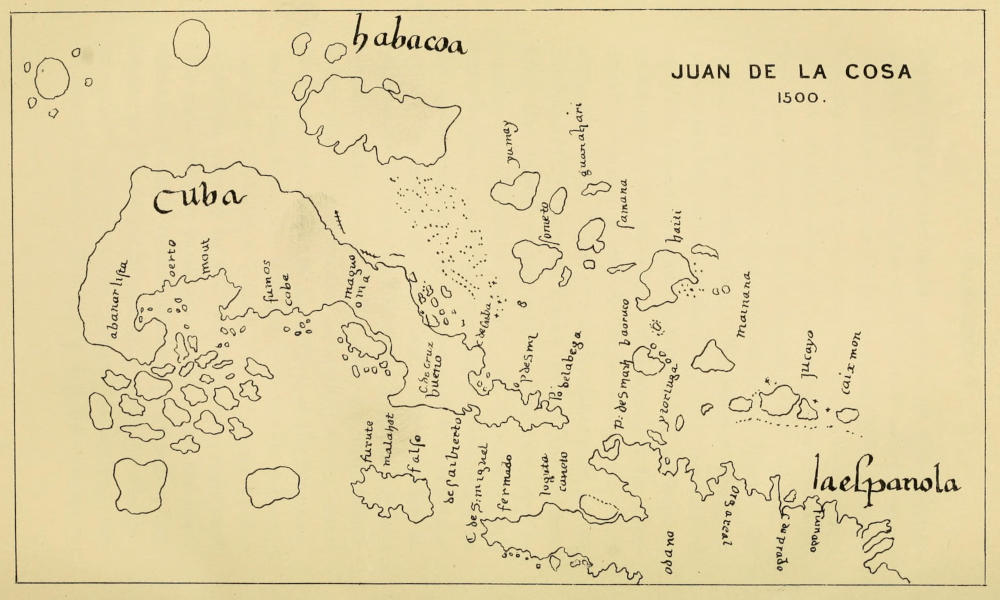
JUAN DE LA COSA
1500.
It is needless to dwell here upon the events which followed this discovery, as they are for the most part described in the letter here translated. The main result of the voyage was the discovery of the islands of St. Salvador, Santa Maria de la Concepcion, Exuma, Isabella, Cuba, Bohio, the Archipelago off the south coast of Cuba (which he names the Jardin del Rey, or King’s Garden), the islands of St. Catherine and Hispaniola, on which latter Columbus erected the fortress of La Navidad, and established a colony. Finally, on the 16th of January, he began to steer his course for Spain, and he was already near the Azores when, on the 12th February, [lxiv]the wind came on to blow violently, with a heavy sea, and on the following day a frightful tempest broke upon them, which obliged them to scud under bare poles. The storm continuing with unabated violence, on the night of the 14th of February the two caravels parted company, each following the course where the fury of the tempest drove them. The sailors, giving themselves up for lost, offered up prayers and vows; while the admiral, full of gloomy apprehensions that, after all, his discovery might turn to nought, and his two sons be left destitute, wrote upon parchment the account of the voyage, addressed it to the king of Spain, with a promise, written outside, of one thousand ducats to whomsoever would deliver it unopened. He then wrapped the packet up in waxed cloth, and put it into the middle of a cake of wax, and after inclosing it in a barrel well hooped and stopped up, he threw it into the sea. He also placed on the poop of his own vessel a similar barrel, with the same account enclosed, in order that if the ship went to the bottom the barrel might float, and the narrative be saved. During this period Columbus passed three days and nights without sleep, and with scanty and bad food, so that when, on the 18th, he arrived at St. Mary’s, one of the Azores, he felt his limbs quite crippled with exposure to the cold and wet. There was a small church there, in a solitary place, dedicated to the Virgin. Columbus, with the view of discharging the vows made during the storm, sent half of his people on shore to the church, but the Portuguese Governor of the island took them all [lxv]prisoners, seized their boat, and would have attacked Columbus’s own vessel, by orders, as he said, received from his court, but for the firmness with which the latter confronted him. Columbus indignantly asserted his own rank and office, showed his letters patent sealed with the royal seal, and threatened the Governor with the vengeance of the Castilian government. After a few days, during which Columbus was driven from his anchorage and had to beat about in great danger, the Governor, who in the interval had thought better of the matter, liberated the prisoners and allowed the caravel to proceed on her course. The state of the weather was most terrible; the sea ran mountains high; the lightnings rent the clouds, and the violence of the winds was such that the vessel was obliged to scud under bare poles, in which state she arrived, at last, in the Tagus, near Lisbon, on the 4th of March. Columbus immediately wrote a letter to the King of Portugal, then at Valparaiso, informing him that he was not come from Guinea but from the Indies, and requesting protection for his caravel, and permission to bring it up to Lisbon. Not only was this granted, but Columbus was immediately invited to Valparaiso and was received by the monarch and his courtiers with the highest honours. There were not wanting, however, some who would gladly have slain him to prevent his going to Castile as the bearer of such great and glorious news. The magnanimity of the king prevented this injustice, and leaving Portugal in safety, on the 13th of March, Columbus [lxvi]arrived on the 15th at the little port of Palos, from whence he had sailed on the 3rd of August in the preceding year. Meanwhile Pinzon, the captain of the other caravel, who in the late storm had been driven into Galicia, wished to anticipate the admiral, but an express order from the court, forbidding him to come without Columbus, made him actually die of spite and chagrin. The reception of Columbus in Spain was such as the grandeur and dignity of his unrivalled achievement deserved, and his entrance into Barcelona was scarcely inferior to a Roman triumph.[17]
[lxvii]
Very shortly after his arrival the papal bull was obtained, which fixed the famous line of demarcation, determining the right of the Spanish and Portuguese to discovered lands. This line was drawn from the north to the south pole, at a hundred leagues west of the Azores and Cape de Verde islands; the discoveries to the westward were to belong to Spain, and those to the eastward to Portugal.
The seductive adulation of the court and the people did not, however, divert the thoughts of Columbus [lxviii]from the preparations for a second expedition. A stay of five months sufficed to make all ready for this purpose; but these preparations gave rise to a malignant feeling towards him on the part of Juan Rodriguez Fonseca, Bishop of Badajos, which eventually led to such disgraceful ill-usage of the admiral as will remain a stain upon the character of Spain while the name of Columbus exists in the memory of man.
On the 25th September 1493, Columbus took his departure from Cadiz, with a fleet of three large ships of heavy burthen, and fourteen caravels, and after a pleasant voyage reached the island of Dominica on the 3rd of November. The letter of Dr. Chanca, here translated, gives an interesting description of a considerable portion of the events of this voyage, but it is to be regretted that his account terminates so abruptly, and the “memorial” of Columbus to the sovereigns adds but few incidents of moment to the narrative. We should be straining the necessary limits of a mere introduction to these translated documents, were we to undertake to lead the reader through the various history of this eventful period of the life of Columbus. Such a task has been rendered perfectly unnecessary by the much admired work of Washington Irving. Suffice it that we state, that the principal geographical information supplied by this voyage consists in the discovery of the Caribbee Islands, Jamaica, an Archipelago (named by Columbus the Queen’s Gardens, supposed to be the Morant Keys), Evangelista, or the Isle of Pines; and the island of Mona.
[lxix]
He sailed with his fleet finally for Spain on the 28th of April, 1496, and after nearly two months’ struggle against the trade-winds (during which provisions became so reduced, that there was talk of killing, and even eating the Indian prisoners), reached the bay of Cadiz on the 11th of June. The emaciated state of the crew when they disembarked, presenting so mournful a contrast with the joyous and triumphant appearance which they were expected to make, produced a very discouraging impression upon the opinions of the public, and reflected a corresponding depression upon the spirits of Columbus himself. He was reassured, however, by the receipt of a gracious letter from the sovereigns inviting him to the court, which was the more gratifying to him that he had feared he had fallen into disgrace. He was received with distinguished favour, and had a verbal concession of his request to be furnished with eight ships for a third voyage. He was doomed, however, to have his patience severely tried by the delay which occurred in the performance of this promise, which was partly attributable to the engrossing character of the public events of the day, and partly to the machinations of his inveterate enemy, the bishop Fonseca.
It was not till the 30th of May 1498, that he set sail from San Lucar, with six of the eight vessels promised, the other two having been despatched to Hispaniola, with provisions, in the beginning of the year. When off Ferro he despatched three of his six vessels to the same island, with a store of fresh supplies for the colony, while with his remaining three [lxx]he steered for the Cape Verde Islands, which he reached on the 27th of June. On the 5th of July he left Boavista, and proceeded southward and westward. In the course of this voyage the crews suffered intensely from the heat, having at one time reached the fifth degree of north latitude, but at length land was descried on the 31st of July,—a most providential occurrence, as but one cask of water remained in the ship. The island they came to formed an addition to his discoveries; and as the first land which appeared consisted of three mountains, united at their base, he christened the island, from the name of the Trinity, La Trinidad. It was in this voyage that he discovered terra firma,[18] and the islands of Margarita and Cubagua. His supposition that Paria had formed the original abode of our first parents, is curiously described in our translated letter; and to a careful observer the sagacity of his mode of reasoning is perceptible even in a speculation so fanciful as this. On reaching Hispaniola (to which he was drawn by his anxiety on account of the infant colony), he had the mortification to find that his authority had suffered considerable diminution, and that the colony was in a state of organized rebellion. He had scarcely, by his active and at the same time politic conduct, brought matters to a state of comparative tranquillity, when a new storm gathered round him from the quarter of the Spanish court. The hatred of his ancient enemies [lxxi]availed itself of the clamour raised against him by some of the rebels who had recently returned to Spain, and charges of tyranny, cruelty, and ambition were heaped unsparingly upon him. The king and queen, wearied with reiterated complaints, at length resolved to send out a judge, to inquire into his conduct,—injudiciously authorizing him to seize the governorship in the place of Columbus, should the accusations brought against him prove to be valid. The person chosen was Don Francisco de Bobadilla, whose character and qualifications for the office are best demonstrated by the fact, that, on the day after his arrival in Hispaniola, he seized upon the government before he had investigated the conduct of Columbus, who was then absent; he also took up his residence in his house, and took possession of all his property, public and private, even to his most secret papers. A summons to appear before the new governor was despatched to Columbus, who was at Fort Concepcion; and in the interval between the despatch of the summons and his arrival, his brother, Don Diego, was seized, thrown into irons, and confined on board of a caravel, without any reason being assigned for his imprisonment. No sooner did the admiral himself arrive, than he likewise was put in chains, and thrown into confinement. The habitual reverence due to his venerable person and exalted character, made each bystander shrink from the task of fixing the fetters on him, till one of his own domestics, described by Las Casas as “a graceless and shameless cook,” filled up the measure of ingratitude [lxxii]that he seemed doomed to experience, by riveting the irons, not merely with apathy, but with manifest alacrity. In this shackled condition he was conveyed, in the early part of October, from prison to the ship that was to convey him home; and when Andreas Martin, the master of the caravel, touched with respect for Columbus, and deeply moved at this unworthy treatment, proposed to take off his irons, he declined the offered benefit, with the following magnanimous reply: “Since the king has commanded that I should obey his governor, he shall find me as obedient in this as I have been to all his other orders; nothing but his command shall release me. If twelve years’ hardship and fatigue; if continual dangers and frequent famine; if the ocean first opened, and five times passed and repassed, to add a new world, abounding with wealth, to the Spanish monarchy; and if an infirm and premature old age, brought on by these services, deserve these chains as a reward, it is very fit I should wear them to Spain, and keep them by me as memorials to the end of my life.” This in truth he did; for he always kept them hung on the walls of his chamber, and desired that when he died they might be buried with him.
His arrival in Spain in this painful and degraded condition produced so general a sensation of indignation and astonishment, that a warm manifestation in his favour was the immediate consequence. A letter (here translated), written by him to Doña Juana de la Torre, a lady of the court, detailing the wrongs he had suffered, was read to queen Isabella, [lxxiii]whose generous mind was filled with sympathy and indignation at the recital. The sovereigns hastened to order him to be set at liberty, and ordered two thousand ducats to be advanced, for the purpose of bringing him to court with all distinction and an honourable retinue. His reception at the Alhambra was gracious and flattering in the highest degree; the strongest indignation was expressed against Bobadilla, with an assurance that he should be immediately dismissed from his command, while ample restitution and reward were promised to Columbus, and he had every sanction for indulging the fondest hopes of returning in honour and triumph to St. Domingo. But here a grievous disappointment awaited him; his re-appointment was postponed from time to time with various plausible excuses. Though Bobadilla was dismissed, it was deemed desirable to refill his place for two years, by some prudent and talented officer, who should be able to put a stop to all remaining faction in the colony, and thus prepare the way for Columbus to enjoy the rights and dignities of his government both peacefully and beneficially to the crown. The newly-selected governor was Nicolas de Ovando, who, though described by Las Casas as a man of prudence, justice, and humanity, certainly betrayed a want both of generosity and justice in his subsequent transactions with Columbus. It is possible that the delay manifested by the sovereigns in redeeming their promise might have continued until the death of Columbus, had not a fresh stimulant to [lxxiv]the cupidity of Ferdinand been suggested by a new project of discovering a strait, of the existence of which Columbus felt persuaded from his own observations, and which would connect the New World which he had discovered with the wealthy shores of the east. His enthusiasm on the subject was heightened by an emulous consideration of the recent achievements of Vasco da Gama and Cabral, the former of whom had, in 1497, found a maritime passage to India by the Cape, and the latter, in 1500, had discovered for Portugal the vast and opulent empire of Brazil. The prospect of a more direct and safe route to India than that discovered by da Gama, at length gained for Columbus the accomplishment of his wish for another armament; and, finally, on the 9th of May, 1502, he sailed from Cadiz on his fourth and last voyage of discovery.
It is painful to contrast the splendour of the fleet with which Ovando left Spain to assume the government of Hispaniola, with the slender and inexpensive armament granted to Columbus for the purpose of exploring an unknown strait into an unknown ocean, the traversing of whose unmeasured breadth would complete the circumnavigation of the globe. Ovando’s fleet consisted of thirty sail, five of them from ninety to one hundred and fifty tons burden, twenty-four caravels of from thirty to ninety tons, and one bark of twenty-five tons; and the number of souls amounted to about two thousand five hundred. The heroic and injured man, to whose unparalleled combination of noble qualities, the very dignity which called for all [lxxv]this state was indebted for its existence, had now in the decline of his years and strength, and stripped both of honour and emolument, to venture forth with four caravels,—the largest of seventy, and the smallest of fifty tons burthen—accompanied by one hundred and fifty men, on one of the most toilsome and perilous enterprises of which the mind can form a conception.
On the 20th of May he reached the Grand Canary, and starting from thence on the 25th, took his departure for the west. Favoured by the trade winds, he made’a gentle and easy passage, and reached one of the Caribbee Islands, called by the natives Matinino (Martinique), on the 15th of June. After staying three days at this island, he steered northwards, and touched at Dominica, and from thence directed his course, contrary to his own original intention and the commands of the sovereigns, to St. Domingo. His reason was that his principal vessel sailed so ill as to delay the progress of the fleet, which he feared might be an obstacle to the safety and success of the enterprise, and he held this as a sufficient motive for infringing the orders he had received. On his arrival at San Domingo, he found the ships which had brought out Ovando ready to put to sea on their return to Spain. He immediately sent to the governor to explain that his intention in calling at the island was to procure a vessel in exchange for one of his caravels, which was very defective; and further begged permission for his squadron to take shelter in the harbour, from [lxxvi]a hurricane, which, from his acquaintance with the prognostics of the weather, he had foreseen was rapidly approaching. This request was ungraciously refused; upon which Columbus, though denied shelter for himself, endeavoured to avert the danger of the fleet, which was about to sail, and sent back immediately to the governor to entreat that he would not allow it to put to sea for some days. His predictions and requests were treated with equal contempt, and Columbus had not only to suffer these insulting refusals and the risk of life for himself and squadron, but the loud murmurings of his own crew that they had sailed with a commander whose position exposed them to such treatment. All he could do was to draw his ships up as close as possible to the shore, and seek the securest anchorage that chance might present him with. Meanwhile the weather appeared fair and tranquil, and the fleet of Bobadilla put boldly out to sea. The predicted storm came on the next night with terrific fury, and all the ships belonging to the governor’s fleet, with the exception of one, were either lost, or put back to San Domingo in a shattered condition. The only vessel that escaped was the one which had been freighted with some four thousand gold pieces, rescued from the pillage of Columbus’s fortune. Bobadilla, Roldan, and a number of the most inveterate enemies of the admiral, perished in this tremendous hurricane, while his own fleet, though separated and considerably damaged by the storm, all arrived safe at last at Port Hermoso, on the south of San Domingo. [lxxvii]He repaired his vessels at Port Hermoso, but had scarcely left the harbour before another storm drove him into Port Brazil, more to the westward. On the 14th of July he left this port, steering for terra firma, and on the 30th discovered the small island of Guanaga or Bonacca, a few leagues east of the bay of Honduras. He continued an eastern course, and discovered the cape now known as Cape Honduras. While moving along this coast, he experienced one of those frightful tempests to which the tropics are liable, and of which he gives so impressive a description in the letter we have translated. At length, after forty days’ struggle to make as much as seventy leagues from the cape of Honduras, he reached a cape, by doubling which he found a direct southward course open, offering at the same time an unobstructed navigation and a favourable wind. To commemorate this sudden relief from toil and danger, Columbus named this point Cape Gracias a Dios, or “Thanks to God.” A melancholy occurrence took place on the 16th of September, while they were anchored off this coast. The boats had been sent up a large river to procure supplies of wood and water, when, on returning, the encounter of the sea with the rapid current of the river caused so violent and sudden a commotion, that one of the boats was swallowed up, and all on board perished. On the 25th of September he reached Cariay, or Cariari, where he stayed till the 5th of October. The next point was the Bay of Carumbaru, which was the first place on that coast where he met with specimens of pure gold. Leaving this bay on [lxxviii]the 17th of October, he sailed along the coast of Veragua, and here he was informed by the Indians of the wealthy country of Ciguare, which he supposed to be some province belonging to the Grand Khan, and also of a river ten days’ journey beyond Ciguare, which he conceived to be the Ganges. On the 2nd of November he discovered Puerto Bello, in which harbour he was detained till the 9th by stormy weather; when, continuing his course eastward, he reached, near the end of the month, a small harbour, to which he gave the name of El Retrete, or the Cabinet. It was here that a continuance of stormy weather, in addition to the murmurs of his crew at-being compelled to prosecute an indefinite search, with worm-eaten ships, against opposing currents, determined Columbus on relinquishing his eastward voyage for the present, and to return in search of the gold mines of Veragua. But on altering his course to the westward, he had the mortification to find the wind for which he had long been wishing, come now, as if in direct opposition to his adopted course, and for nine days he was exposed to so terrible a storm that it was a marvel how his crazy vessels could outlive it. At length, after a month’s anxiety and suffering, they anchored, on the day of the Epiphany, at the mouth of a river called by the natives Yebra, but which Columbus named Belem, or Bethlehem. Here a settlement was formed, and here occurred the sad disasters and conflicts with the natives, which he describes in his letter from Jamaica, and in which the faithful and zealous Diego Mendez proved an [lxxix]eminently efficient assistant to his much loved master. The history of this unhappy voyage, the toils and perils of which were aggravated to Columbus by extreme bodily suffering, closes by his reaching Jamaica, where he would in all probability have perished, but for the devotedness and activity of Mendez. The highly interesting description of that brave man’s exploits on behalf of Columbus, has been quoted by Navarrete from his will, and is here translated. When at length, through the agency of Mendez, two ships arrived from Hispaniola to the assistance of the admiral, he was enabled, on the 28th of June, 1504, to leave his wrecked vessels behind him, and start with revived hopes for San Domingo, which he reached on the 13th of August. His sojourn there was not, as may be judged, calculated to afford him satisfaction or pleasure. The overstrained courtesy of the governor offered but a poor alleviation to the rush of rankling feelings which the past associations and present desolation of the place summoned up to his mind.
On the 12th of September he set sail for Spain, and the same tempestuous weather which had all along tended to make this his last voyage the most disastrous, did not forsake him now. The ship in which he came home sprung her mainmast in four places in one tempest, and in a subsequent storm the foremast was sprung, and finally, on the 7th of November, he arrived, in a vessel as shattered as his own broken and care-worn frame, in the welcome harbour of San Lucar.
The two years which intervened between this [lxxx]period and his death present a picture of black ingratitude on the part of the crown to this distinguished benefactor of the kingdom, which it is truly painful to contemplate. We behold an extraordinary man, the discoverer of a second hemisphere, reduced by his very success to so low a state of poverty that, in his prematurely infirm old age, he is compelled to subsist by borrowing, and to plead, in the apologetic language of a culprit, for the rights of which the very sovereign whom he has benefited has deprived him. The death of the benignant and high-minded Isabella, in 1505, gave a finishing blow to his hope of obtaining redress, and we find him thus writing subsequently to this period to his old and faithful friend Diego de Deza:—“It appears that his majesty does not think fit to fulfil that which he, with the queen, who is now in glory, promised me by word and seal. For me to contend for the contrary, would be to contend with the wind. I have done all that I could do: I leave the rest to God, whom I have ever found propitious to me in my necessities.” The selfish and cold-hearted Ferdinand beheld his illustrious and loyal servant sink, without relief, under bodily infirmity, and the palsying sickness of hope deferred; and at length, on the 20th of May 1506, the generous heart which had done so much without reward and suffered so much without upbraiding, found rest in a world where neither gratitude nor justice is either asked or withheld.
His body was in the first instance buried at Valladolid, in the parish church of Santa Maria de la [lxxxi]Antigua, but was transferred, in 1513, to the Cartuja de las Cuevas, near Seville, where a monument was erected over his grave with the memorable inscription,—
A CASTILLA Y A LEON
NUEVO MUNDO DIÓ COLON.
In the year 1536, both his body, and that of his son Diego, who had been likewise buried in the Cartuja, were transported to St. Domingo, and deposited in the cathedral of that city. From hence they were removed to Havannah in 1795, on the cession of Hispaniola to the French, and the ashes of the immortal discoverer now quietly repose in the cathedral church of that city.[19]
[lxxxii]
But injustice, unhappily, was not buried with Columbus in the tomb. It was but one twelvemonth after his death that an attempt was made, and only too successfully, to name the new world which he had discovered, after another, who was not only his inferior, but his pupil in the school of maritime enterprise. In an obscure corner of Lorraine, at the little cathedral town of St. Dié, a cluster of learned priests, who had there established a printing-press under the auspices of René II, Duke of Lorraine, suggested to give to the newly discovered continent the name of the Florentine, Amerigo Vespucci, whose nautical career did not commence till after Columbus had returned from his second voyage to the western hemisphere. The first time that the name of Amerigo came into notice was in the year 1504, when Johann Ottmar published at Augsburg the Mundus Novus, a description of Vespucci’s third voyage, now extremely rare, embodied in a letter addressed by Vespucci [lxxxiii]himself to Lorenzo di Pier Francesco de’ Medici. In this voyage, which occupied from May 1501 to September 1502, he was in the service of Portugal, and explored the coasts of South America as far as beyond the fifty-second degree. But it was not till May, 1507, when Columbus had been a twelvemonth dead, that the world was informed of four voyages professed to have been made by Vespucci, of which the one just mentioned was only the third, the two former having been made, as he states, in the service of Spain. As the first of these was asserted to have taken place between May 20th, 1497, and October, 1499 [say 1498], and, if correct, would involve the discovery by him not only of the north coasts of South America, but a large extent of the coast of North America also, and that in priority of the claims both of Cabot and Columbus as regards the discovery of the American continent, it has been a matter of keen interest to many to examine minutely the correctness of Vespucci’s claim to having made this voyage.
It would be out of place here to enter into the complicated arguments in which this question is involved; but I have elsewhere shown[20] on how frail a tenure the claim in question is founded. In the same place I have also traced in detail the mode adopted for giving to the New World the name of Vespucci instead of that of Columbus, who, by the exercise of such transcendently superior qualities had earned for himself that honour. I will here sketch [lxxxiv]it in brief. Vespucci was an intimate friend of the Giocondi family, one of whom, the celebrated architect, Fra Giovanni Giocondi, who built the bridge of Nôtre Dame at Paris, was the translator into Latin of Vespucci’s letter to Lorenzo di Pier Francesco de’ Medici describing his third voyage. A young Alsatian, named Mathias Ringmann, who was at this time pursuing his studies in Paris, appears to have made the acquaintance of this Giocondi and to have carried back with him into Alsace an admiration for Vespucci and his achievements, which showed itself in his editing at Strasbourg in 1505, Giocondi’s translation of Vespucci’s letter, accompanied by some laudatory verses in Latin by himself. Now in the neighbouring province of Lorraine, one of the canons of the cathedral at St. Dié, Walter Lud, who was secretary to René II, Duke of Lorraine, had already for many years established a gymnasium or college under the duke’s auspices, and also a printing-press. Ringmann, better known in literature by the pseudonym of Philesius, became professor of Latin at the college and corrector of the press in the printing-office. On the 25th of April, 1507, a year after the death of Columbus, one of the members of this little clique, named Martin Waldseemüller, otherwise known as Hylacomylus, produced from this press a small work entitled Cosmographiæ Introductio, to which was appended a Latin translation of Vespucci’s four voyages, as described by himself and addressed to Duke René II, although it can be shown by the contents to have been really intended for [lxxxv]Pietro Soderini, Gonfaloniere of Florence, who had been Vespucci’s schoolfellow. In my Life of Prince Henry the Navigator, I have ventured to suggest the process by which these letters, intended for another, came to be addressed to Duke René, and that suggestion supplies the solution of some riddles, there treated of, which it would be out of place to speak of here. We have seen the connection of the Giocondi with Vespucci. We have seen, also, the connection of Ringmann with the work of Fra Giovanni Giocondi and his interest in the glory of Vespucci. This interest he infuses into the little circle of St. Dié, and we can imagine their pleasure at having the opportunity of blazoning forth to the world, from their own printing-press, a story which would throw so bright a reflection on the obscurity of their secluded valley. But in the little book thus issued, not only were printed for the first time four voyages of Vespucci, but also a suggestion was made that from his name, Amerigo, should be given the name of “Amerige” or “America” to the newly-discovered western world. In September of the same year, 1507, appeared a re-issue of the same book; and in 1509 a new edition of it was issued from the printing-press of Johann Grüninger of Strasburg. In this same year, 1509, three years before the death of Vespucci, the name of America appears, as if it were already accepted as a well-known denomination, in an anonymous work entitled Globus Mundi, printed also at Strasburg. But although this work is anonymous, it was my good fortune to detect from the colophon, [lxxxvi]in which occur the words “Adelpho Castigatore,” that the source of the suggestion of the name of America in the one case, and of the adoption of the suggestion in the other, are either identical or in close proximity, inasmuch as the already mentioned re-issue of the Cosmographiæ Introductio in 1509, has in the colophon, “Johanne Adelpho Mulicho Argentinensi Castigatore.” Now, Mulicho merely means native of Muhlingen, near Strasburg, and this Adelphus, so named, was a physician established in that city, and reviser of both the one work and the other.
The first place in which we find the name of America used a little further a-field, is in a letter dated Vienna, 1512, from Joachim Vadianus to Rudolphus Agricola, and inserted in the Pomponius Mela of 1518, edited by the former. The expression used is “America discovered by Vesputius.”[21] But although this Vadianus, whose real name was Joachim Watt, writes from Vienna in 1512, I find that he was a native of St. Gall, whence in 1508, being then twenty-four years old, he went to the High School of Vienna. His learned disputations and verses gained him the chair of the professorship of the liberal arts at that school, and he subsequently studied medicine, of which faculty he obtained the doctorate. This attachment to the study of medicine recalls to my mind a fact which awakens a suspicion that he may have been a personal friend of John Adelphus, just referred to, and if so, of the little confraternity of St. Dié. Before Adelphus established himself in Strasburg, he [lxxxvii]had practised as a physician at Schaffhausen, and this at the time when Joachim Watt was a young man, still resident at St. Gall, which is distant from Schaffhausen seventy English miles, a distance which would offer very little hindrance to Swiss intercommunication. Whether this suspicion be worth anything or no, I advance it as a possible clue to yet further researches which may show the process by which this spurious appellation of America became adopted, through the efforts of a small cluster of men in an obscure corner of France.
The earliest engraved map of the new world yet known as bearing the name of America, is a mappe-monde by Appianus, bearing the date of 1520, annexed to the edition by Camers of the Polyhistoria of Julius Solinus (Viennæ Austr., 1520), and a second time to the edition of Pomponius Mela by Vadianus, printed at Basle in 1522. The earliest manuscript map hitherto found bearing that name, is in a most precious collection of drawings by the hand of Leonardo da Vinci, now in Her Majesty’s collections at Windsor, to which, from an examination of its contents, I have assigned the date of 1513-14.[22]
I have thus endeavoured to unravel the intricate story of a great and irreparable injustice. No one can deny to Vespucci the credit of possessing courage, perseverance, and a practical acquaintance with the art of navigation; but he had never been the commander of an expedition, and had it not been for the great initiatory achievement of Columbus, we [lxxxviii]have no reason to suppose that we should ever have heard his name.
“To say the truth,” as has been well remarked by the illustrious Baron von Humboldt, “Vespucci shone only by reflection from an age of glory. When compared with Columbus, Sebastian Cabot, Bartolomé Dias, and Da Gama, his place is an inferior one. The majesty of great memories seems concentrated in the name of Christopher Columbus. It is the originality of his vast idea, the largeness and fertility of his genius, and the courage which bore up against a long series of misfortunes, which have exalted the Admiral high above all his contemporaries.”
A tardy tribute has been at length paid to his memory by his fellow-citizens of Genoa, and the first stone of a monument in commemoration of his achievements was laid in that city on the 27th of September, 1846, and completed in 1862. There is now serious talk of his canonization.
Among the many so-called portraits of Columbus, too numerous to be detailed here, but for elaborate notices of which the reader is referred to the works mentioned at foot,[23] there is not one that can be regarded as unquestionably authentic. It was at the [lxxxix]suggestion of my friend M. Ferdinand Denis, the distinguished Librarian of the Ste. Geneviève in Paris, that I have inserted as the frontispiece to this volume a chromolithograph fac-simile of the St. Christopher on the famous map of Juan de la Cosa, Columbus’s pilot, made in 1500. My friend most reasonably suggests that, in this case, St. Christopher represented Christopher Columbus carrying the Christian faith across the Atlantic, and that the face would be a portrait. In corroboration of his idea, I may quote the words of Herrera, whose possession of the Columbian documents enabled him to speak with accuracy. He says, “Columbus was tall of stature, with a long and imposing visage. His nose was aquiline; his eyes blue; his complexion clear, and having a tendency to a glowing red; the beard and hair red in his youth, but his fatigues early turned them white.” The cap and costume seem also less those of the saint than of the sailor. It is to my late revered and dear friend, His Excellency the Count de Lavradio, that I am indebted for procuring the coloured photograph from the original map on his visit to Madrid in 1869. The chromolithograph has been prepared in Berlin.